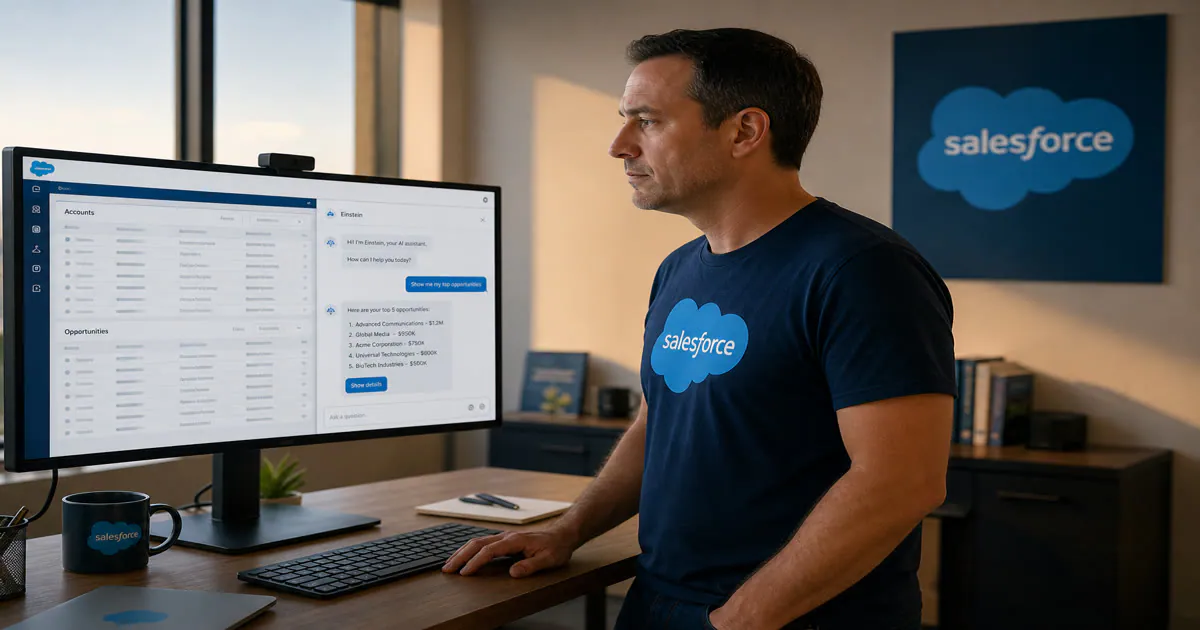
Imagine typing a question into a single search bar and getting, in seconds, an answer that would once have required an hour of manual work. That idea, which not long ago sounded like science fiction, is already changing how teams work.
For years, office work carried an invisible cost: the time that evaporates while you hunt for information scattered across systems that don't talk to each other. Today, artificial intelligence agents attack that problem at the root.
In this article we explain, without jargon, what it means for AI to "live" inside your tools. We also look at why this is one of the deepest changes of the last decade in enterprise software.
The silent problem: the swivel chair
One image sums up the day of millions of professionals: the swivel chair. It is the routine of turning from one monitor to another, opening tabs, copying data and pasting it somewhere else.
Every time a sales rep needs a customer's history, they open the CRM. Then they open billing, then email, and then a spreadsheet.
The result is a constant trickle of lost minutes. Added up over a week, those minutes become entire days of productivity thrown away.
The most frustrating part is that the information already exists. The problem is not a lack of data, but that it is fragmented and trapped in places that don't talk to each other.
This drain is known as the swivel chair problem. It is invisible on the balance sheet, but brutal in day-to-day practice.
What does it mean for AI to live in the search bar?
The idea is simple to understand and powerful in its impact. Instead of making you travel to the data, AI brings the data to you.
Picture a smart search bar placed at the center of your work. It doesn't just look for files or names: it understands what you need and acts on it.
This new generation of AI agents connects directly to your company's information. It accesses your customer data, your workflows, your opportunities and your open cases.
The key difference is that it doesn't stop at finding things. Once it understands the request, it takes action in real time.
It is like going from a library index to an expert librarian. One tells you where the book is; the other brings it to you, summarizes it and suggests the next step.
From searching for data to talking with your data
This is where the most interesting leap happens. We stop "searching" in the classic sense and start talking with the information.
Instead of learning complex filters or query languages, you ask in plain English. The tool interprets your intent and returns an answer ready to use.
This approach is the heart of conversational business intelligence. It lets anyone on the team, without a technical background, get deep analysis with a simple question.
A manager can ask about sales in the north for the quarter and get the figure instantly. There is no need to wait for the data team to build a report.
This democratizes access to information. The power of real-time data stops being exclusive to specialists and reaches the whole organization.
The coworker who never gets tired
The best way to picture this technology is as a new member of the team. It is not just a program, but a digital collaborator that works alongside you.
This coworker has three qualities that make it unique. It knows the full context of the business, it is available 24 hours a day and it never loses patience.
It works where you work. Whether in your management platform, your messaging app or your team's chat tool, the agent shows up to help.
The underlying idea is to eliminate friction. You no longer need to switch context, open twenty tabs or remember which system held that piece of data.
Answers that turn into actions
A traditional search tool finishes its job when it shows you results. An intelligent agent is just getting started at that point.
Say it detects a stalled opportunity. It doesn't just alert you: it can draft the follow-up, schedule the task and update the record.
This ability to act in real time is what separates a real assistant from a slightly improved search. The difference between informing and resolving is enormous.
And it all happens without copying, pasting or jumping between programs. The workflow becomes continuous and natural.
AI agent or ordinary chatbot: they are not the same thing
This is a good moment to stop and clear up a very common confusion. Many people believe an AI agent is just a slightly livelier chatbot.
A classic chatbot follows a rigid script and replies with prewritten phrases. If you step off the script, it gets stuck or hands you over to a human.
A real agent is something else: it reasons, decides and executes. It understands the context, queries the right systems and completes the task from start to finish.
The difference is felt right away in use. One makes you waste time with menus; the other solves the problem and moves on.
What this looks like in practice
Theory is nice, but the real value shows up in the day-to-day of each area. Let's see how an AI coworker transforms different business functions.
The examples that follow cover sales, marketing, documents and logistics. In each case the same pattern repeats, regardless of the company's industry.
The agent takes on the repetitive tasks and leaves in people's hands what truly moves the needle. That way, the team gains time to think, decide and build relationships.
Faster and more human sales
In sales, speed is almost everything. An agent that lives in the channel where your customers are changes the rules of the game.
A conversational sales solution on WhatsApp handles inquiries, qualifies leads and books meetings on its own. Your human team focuses on closing, not on repetitive tasks.
Customers get immediate answers at any hour. That constant availability is a huge competitive advantage today.
Marketing that really holds a conversation
Marketing stopped being a megaphone and became a dialogue. People expect personalized answers, not generic brochures.
With a conversational marketing approach, every interaction feels individual and timely. AI segments, responds and nurtures each contact according to where they are in their journey.
The result is a closer relationship with your audience. And, along the way, a notable improvement in conversion rates.
Documents that process themselves
Few tasks are as tedious as reading and entering documents by hand. Invoices, contracts and forms eat up valuable hours.
An intelligent document processing tool reads, understands and extracts the data with no manual intervention. What used to take an afternoon now happens in seconds.
This reduces errors and frees people for strategic tasks. Paperwork stops being a bottleneck.
Logistics that arrives on time
The last mile is one of the most expensive challenges in any operation. Coordinating routes, vehicles and schedules is a constant puzzle.
Last-mile logistics optimization uses AI to plan deliveries as efficiently as possible. Fewer miles, lower costs and happier customers.
Every delivery becomes more predictable. Technology brings order to the chaos that used to be handled by sheer intuition.
Why is this happening now?
Many people wonder why this revolution is arriving right now. The answer lies in the maturity of language models.
Until recently, AI understood simple questions but got lost in the real complexity of a company. It could not connect sales data with operations data.
Today, by contrast, agents navigate complex, cross-referenced information with surprising ease. They can join pieces from different systems to build a complete answer.
That evolution changed everything. What used to be a lab promise is now a concrete tool you can rely on.
The role of the CRM ecosystem
A good part of this transformation starts in the world of CRM, where the most valuable information about your customers lives. That is where the contacts, the opportunities and the history of every commercial relationship are.
As specialists in the world's leading customer management platform, we know that the real value appears when that data becomes actionable. Stored data is useless if nobody can use it in time.
The same goes for the large enterprise data platforms that support the most demanding operations. The key is to connect that infrastructure with agents capable of interpreting it.
Security and trust: the foundation of everything
When an AI accesses sensitive information, a logical and necessary question comes up. Who guarantees that this data is protected?
The answer cannot be improvised. Security has to be at the center of the design, not added as a patch at the end.
At Vantegrate we take this topic extremely seriously, as you can see in our approach to platform security. Each agent operates within the permissions and rules that the company defines.
Trust also depends on clarity. That is why we stand behind a data transparency policy that explains how every piece of information is used and protected.
An AI agent should not be a black box. You have the right to know what data it touches, with what permissions and for what purpose.
The cultural shift that comes with AI
Adopting this technology is not just a technical matter, but also a human one. Teams need to learn to work alongside a digital coworker.
The good news is that the learning curve is very short. Since everything is based on talking in natural language, you don't need to be a systems expert.
The fear of "being replaced" usually fades quickly. In practice, AI takes care of the tedious work and frees people for the creative and strategic.
The companies that understand this best treat AI as an amplifier of human talent. It does not replace people: it empowers them.
If you are interested in how we approach these projects, you can learn who we are and how we work. Behind every agent is a team that thinks about real results.
The first step toward frictionless work
The transition to an AI teammate does not have to be abrupt. The ideal is to start with one specific area and expand from there.
It pays to choose a process that hurts, the one everybody knows takes up too much time. That is where the impact shows up fastest and trust is built.
The best way to understand it is to see it working with your own data. That is why the simplest step is to book a demo and experience the change live.
Seeing an agent resolve in seconds what used to take hours is often revealing. The promise stops being theory and becomes tangible.
Links included in the PDF:
Intro to Salesforce Agentforce Coworker
https://vantegrate.com/pulse/agentforce-coworkerAnnouncement + Beta status
https://www.salesforceben.com/salesforce-announces-agentforce-coworker-ai-in-every-search-bar/Multi-agent orchestration GA
https://www.techtimes.com/articles/318456/20260616/salesforce-agentforce-multi-agent-orchestration-hits-ga-agent-descriptions-now-drive-reliability.htmWhat Agentforce Coworker is
https://salesforcetrail.com/what-is-agentforce-coworker/Official documentation: About Agentforce Coworker
https://developer.salesforce.com/docs/data/agentforce-coworker/guide/agentforce-coworker-a-about-home.htmlLicenses and prerequisites
https://sfdcdevelopers.com/2026/05/24/agentforce-coworker-ai-integration-in-salesforce-search/Official documentation: Agentforce Coworker Home
https://developer.salesforce.com/docs/data/agentforce-coworker/guide/agentforce-coworker-a-home.htmlOfficial documentation: Turn On Infrastructure / Billing Considerations
https://developer.salesforce.com/docs/data/agentforce-coworker/guide/agentforce-coworker-turn-on-infrastructure.htmlSalesforce security: the platform raises the bar
https://vantegrate.com/pulse/seguridad-salesforce-plataformaAgentforce DX and phishing-resistant MFA in Salesforce
https://vantegrate.com/pulse/agentforce-dx-mfaThe new Salesforce Flow Debug Panel
https://vantegrate.com/pulse/debug-panel-salesforce-flowSalesforce hacks and tricks: the best of the latest releases
https://vantegrate.com/pulse/masterclass-salesforce-hacksReplacing Salesforce or Oracle with AI: the deadly trap
https://vantegrate.com/pulse/cambiar-salesforce-oracle-iaTDX 2026: the point of no return for enterprise software
https://vantegrate.com/pulse/tdx-2026Salesforce picks Vantegrate as speakers at TDX 2026
https://vantegrate.com/pulse/salesforce-tdx-2026Salesforce and Oracle partners at the same time
https://vantegrate.com/pulse/infraestructura-salesforce-oracleTalent trained at Talento Tech for Salesforce
https://vantegrate.com/pulse/talento-tech-salesforce
Frequently asked questions about AI agents at work
Do I need technical knowledge to use an AI agent?
No, and that is exactly the point. These tools are used by chatting in natural language, without programming anything at all.
Will AI replace my team?
It does not replace them: it complements them. It handles repetitive work and looks up data so your people can spend their time on decisions and human relationships.
Is it safe to give it access to my company's information?
Yes, as long as the platform respects existing permissions. A good agent operates within the security rules you define, never outside them.
How long does it take to see results?
Much less than you imagine. When you start with a specific process, the benefits usually show up in the first weeks of use.
Does it work in my industry?
Yes, because the approach adapts to the process, not to the industry. In retail, manufacturing, healthcare or logistics, the agent learns the rules of your operation and works within them.
Where should you start?
The most effective step is to identify the task that consumes the most time today. On that specific pain point, an agent can prove its value right away and open the door to new use cases.