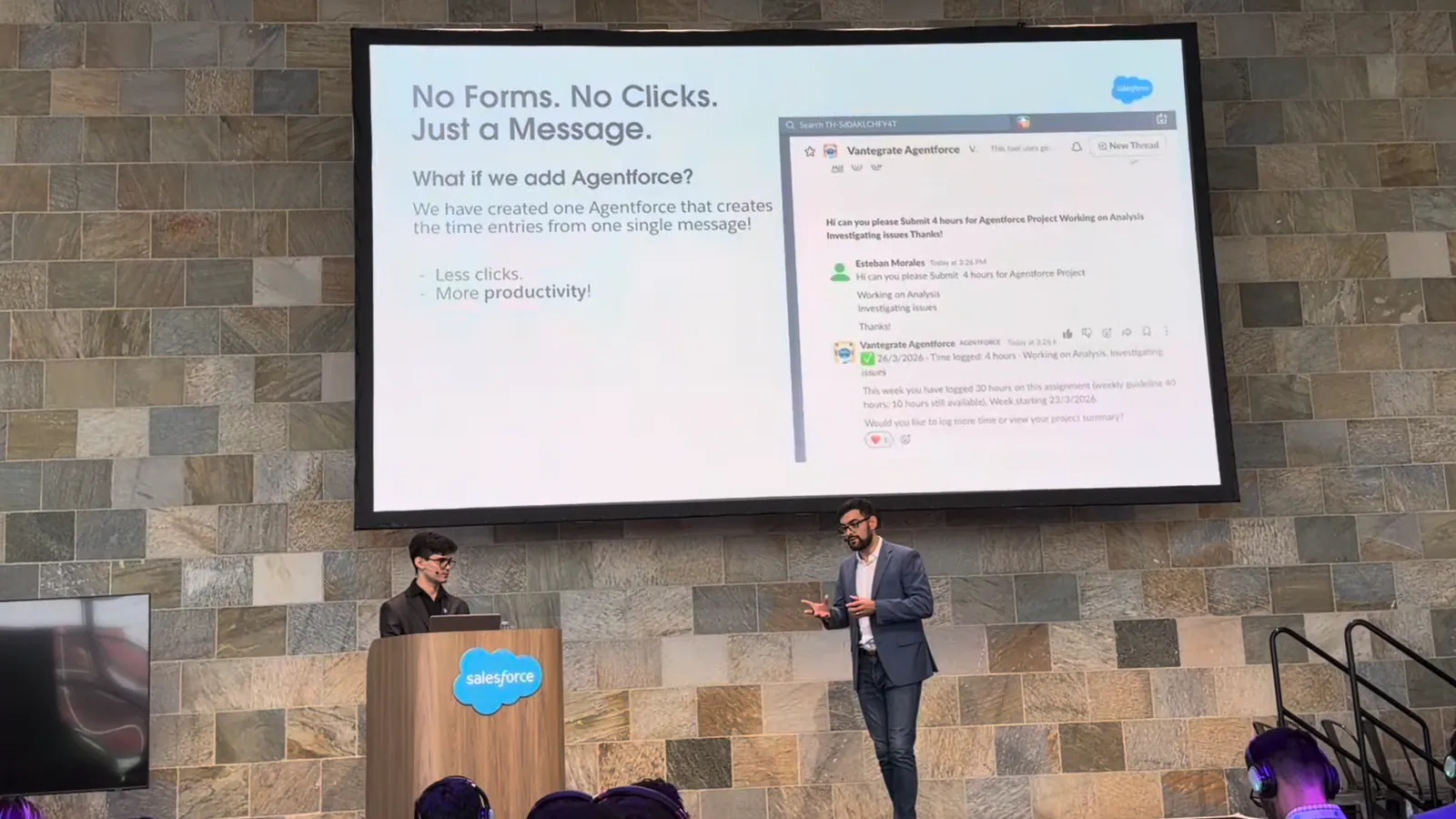
Last year Vantegrate had the chance to take the stage at Dreamforce as a speaker, at one of the most relevant forums in the Salesforce ecosystem.
This year the story repeated itself. Francisco Morales and Esteban Morales traveled to San Francisco to represent the company as presenters, this time with a double agenda.
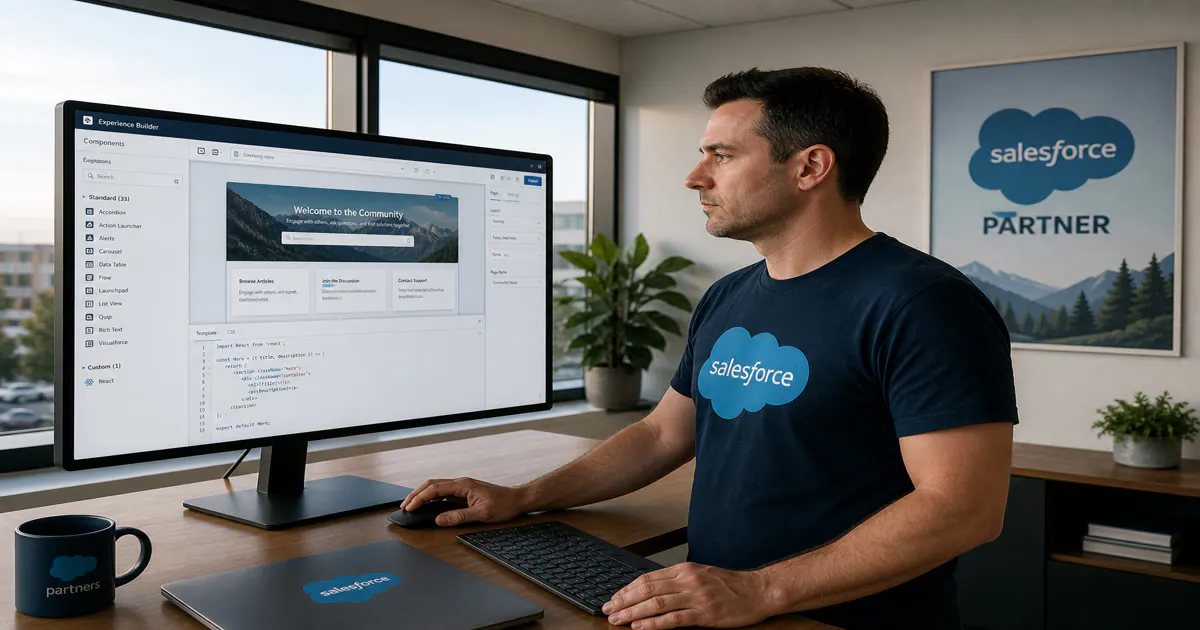
Francisco dove straight into the heart of TDX 2026, the technical conference Salesforce reserves for developers and platform architects.
What Francisco brought back
What Francisco brought back is not a tourist chronicle. It is a strategic read on what is coming at Salesforce and, by extension, on how the big enterprise platforms are rethinking their relationship with developers, with open source and with the new agent economy. At Vantegrate we believe this read is worth recommending to anyone defining their own strategy right now. What follows is the summary.
The shift few people expected
Five years ago, if someone had suggested that Salesforce open-source the code of its agent orchestration language, the proposal would have been dismissed with a mix of disbelief and disinterest. The company had built an empire on the opposite foundation. A closed stack, a controlled AppExchange, an ecosystem of partners and admins trained over two decades. Opening the code was not in the playbook.
What happened on April 15
On April 15, at TDX 2026, Salesforce did exactly that. It published on GitHub the complete Agent Script specification, its grammar, its parser and its compiler. And the curious part is that it was not even the main announcement of the week.
In parallel, it launched Headless 360, a layer that exposes more than 60 new MCP tools and more than 30 preconfigured coding skills (Salesforce, 2026), designed so that a developer can invoke Salesforce from Claude Code, Cursor, Codex or Windsurf without ever opening an admin console.
The question behind the announcement
The question worth asking is not what Salesforce announced, but why one of the most successful enterprise vendors in history decided to abandon years of a closed moat to embrace an open strategy. And above all, what signal that decision sends to the rest of the market.
The new currency of software: tokens
Over the past year, the way software is built has changed at its root, and nothing suggests the pace will slow down. Agentic coding opened the doors of development to millions of people who used to be left out, and at the same time it accelerated the most capable engineers to levels of throughput never seen before.
Software today is produced in the same currency in which AI produces everything else: tokens. The cost curve, for now, flattens accordingly.
Joe Inzerillo, president of Enterprise and AI Technology at Salesforce, put it clearly in the TDX keynote. The 80-20 rule flipped. Getting to a product that works, which used to consume most of the effort, is now achieved in a fraction of the time.
When incumbency becomes a problem
The problem for incumbents is that when a competitor can rebuild your stack at the speed of an agent, your installed-base status stops protecting you. In fact it does the opposite: it paints a sharper target on your back.
You have already validated that there is a market willing to pay for what you offer. Any disruptor has incentives to try to replicate you, and the barrier to building a product has collapsed. The "we'll build it in-house" threat has never been as credible as it is today.
The innovator's dilemma, turned upside down
Christensen's classic theory described how agile entrants displaced slow incumbents by attacking low-potential market segments. The era of agents displaces that framework. Today the challenge for incumbents is not slowness in the face of low-cost disruption, but the speed of replication that coding agents make possible.
Opening up as a defensive move
In that context, opening the code stops being a concession and becomes a defensive move. The fastest-growing projects in the software world are the open ones. The pressure is so strong that some startups buy fake stars on GitHub to sustain adoption narratives in front of venture capital funds that use them as a proxy for interest.
The statistical evidence shows a correlation between GitHub activity and funding: a study of 160,065 startups in the United States found that they intensify their activity on the platform in the twelve months before their first round, and that venture capital funds are the ones that respond most to that activity (Harvard Kennedy School, 2021).
The pressure on enterprise giants
For a company like Salesforce, the math is straightforward. If developers choose open ecosystems, staying closed means being left out of the workflow where the next decade of enterprise software gets decided.
The same logic is starting to strain other giants in the enterprise segment, from Oracle to data platform providers, all forced to redefine how much of their stack they open and how much they keep as a monetizable differentiator.
Three bets that tell the same story
What Salesforce showed at TDX 2026 is not three separate announcements but three faces of the same strategy.
Agent Script on GitHub
Agent Script is a typed, structured language for defining an agent's behavior: when it reasons with an LLM, when it applies deterministic logic, which subagents it can invoke, which variables it tracks, and which guardrails constrain it.
Publishing the full specification, the grammar, the parser and the compiler is not a symbolic gesture. It is an abstraction at the language level, designed to be hard to abandon once adopted.
Headless 360 as a universal tooling layer
Headless 360 turns every Salesforce capability into an MCP tool, a CLI command or an API call. Twenty-five years of integrations become, overnight, tools that anyone else's agent can address.
The explicit target is the developer who lives all day in Claude Code, Cursor or Codex, and who has never touched a Salesforce admin console.
Agentforce Vibes 2.0 and the bet on Claude
Agentforce Vibes 2.0 closes the triangle. The least discussed and possibly most revealing detail is that Vibes 2.0 runs on Claude Sonnet by default.
Developers can switch to GPT or to Salesforce's own models, but the default reflects who Salesforce trusts to generate code on its own platform. Add schema-aware code generation, where Vibes understands what OpportunityLineItem means in a specific org, and the whole picture shows a contextual advantage that generic tools cannot replicate without the data layer Salesforce built over a quarter century.
Adopt at the top, monetize at the bottom
The thesis in a single sentence
Read together, the three plays converge on the same thesis. Open the stack to win developer adoption.
Monetize the enterprise runtime where real production lands, with its audits, its session traceability, its deterministic guardrails and its regulatory regime. And consolidate Slack as the surface where teams do their work.
The enterprise bar according to Nancy Xu
Nancy Xu, VP of Agentforce and AI at Salesforce, sets the bar with a sentence worth remembering. A customer-facing agent in enterprise production can run a million conversations a month, and every one of that million has to comply with the business rules. Regulated industries do not tolerate reliability failures in production, and at the same time they are adopting AI with a growing appetite. Agentforce is the fastest-growing product at Salesforce, and that demand validates the path.
The explicit upgrade path
Adoption runs through GitHub. Billing runs through Agentforce. Slack consolidates as the engagement layer. The upgrade path between them has an explicit connector: the same Agent Script a developer runs on a laptop gets deployed to the hosted Agentforce runtime with all enterprise controls turned on.
For any organization that intends to take agents to production at scale, the lesson is transferable. Reliability, traceability and platform security stop being checklist items and become the real ground of competition.
A new audience for Salesforce
The package includes a $50 million Builders Fund and a clear bet on enabling vibe coding on Salesforce's own infrastructure. It is a formal welcome to an audience that for years came second to the traditional Trailblazers, the admins and low-code power users who sustained the ecosystem for two decades.
A pattern we already know
The playbook of Confluent, Elastic and MongoDB
The play is not new in form. It is the playbook that Confluent applied with Kafka, Elastic with Elasticsearch and MongoDB with its open database, now carried over to the agent layer. The scheme is always the same. Release the foundational piece so the ecosystem adopts it without friction, capture the category as the de facto standard, and charge for the managed infrastructure companies need once that standard goes into production at scale.
The difference of opening from the top
The difference is that Salesforce does not arrive as a young challenger, but as an incumbent with twenty-five years of traction in the enterprise. That combination, opening from the position of a leader rather than from that of an aspirant, is what makes the decision particularly significant.
How we read this at Vantegrate
Same principles, different scale
When you build vertical agents for mid-sized and large companies, as we do at Vantegrate, Salesforce's moves are not distant news. They are operational signals that guide decisions on architecture, models and roadmap. That is why, in our Salesforce practice, we work with the same principles TDX 2026 brought to light. Open languages and tools at the top, a reliable enterprise runtime at the bottom.
Our vertical agents in action
That same architecture is what underpins our vertical agents.
Sellium takes the sales conversation to the channel where most of the region's customers already are: WhatsApp, without losing traceability or control.
Revio organizes conversational marketing with the same guardrail and business rule logic that regulated industries demand.
Metrix turns natural language questions into actionable business intelligence answers, without forcing end users to speak SQL.
Arconte automates the processing of critical documents in operations where auditability is not negotiable.
Trazzo brings that same agentic reliability to last-mile logistics, where every minute counts.
Three lessons for your own agent strategy
The first lesson is that the speed of replication enabled by agentic coding changes the math on traditional moats. What protected you yesterday exposes you today.
Opening up is the new defense
The second is that opening strategic layers is no longer a risk. It is now a defensive tool against that speed. Whoever closes off completely is left out of the flow where standards are formed.
Default bets matter
The third, perhaps the most uncomfortable for many technology teams, is that default bets matter. Who you trust with code generation, which model runs behind your customer-facing agent, which runtime executes your business rules: all of it says more about your technical vision than any keynote slide.
Next steps
The age of agents is only beginning, and the next twelve months will separate the companies that understood the underlying shift from those that keep treating this moment as just another wave of hype. Salesforce, at least, showed its cards.
Let's talk
If you want to talk about how to put all this into practice in your organization, you can review our plans and pricing or book a demo directly with the team. Francisco is coming back from San Francisco with his head full of ideas, and we would love to put them to work for you.