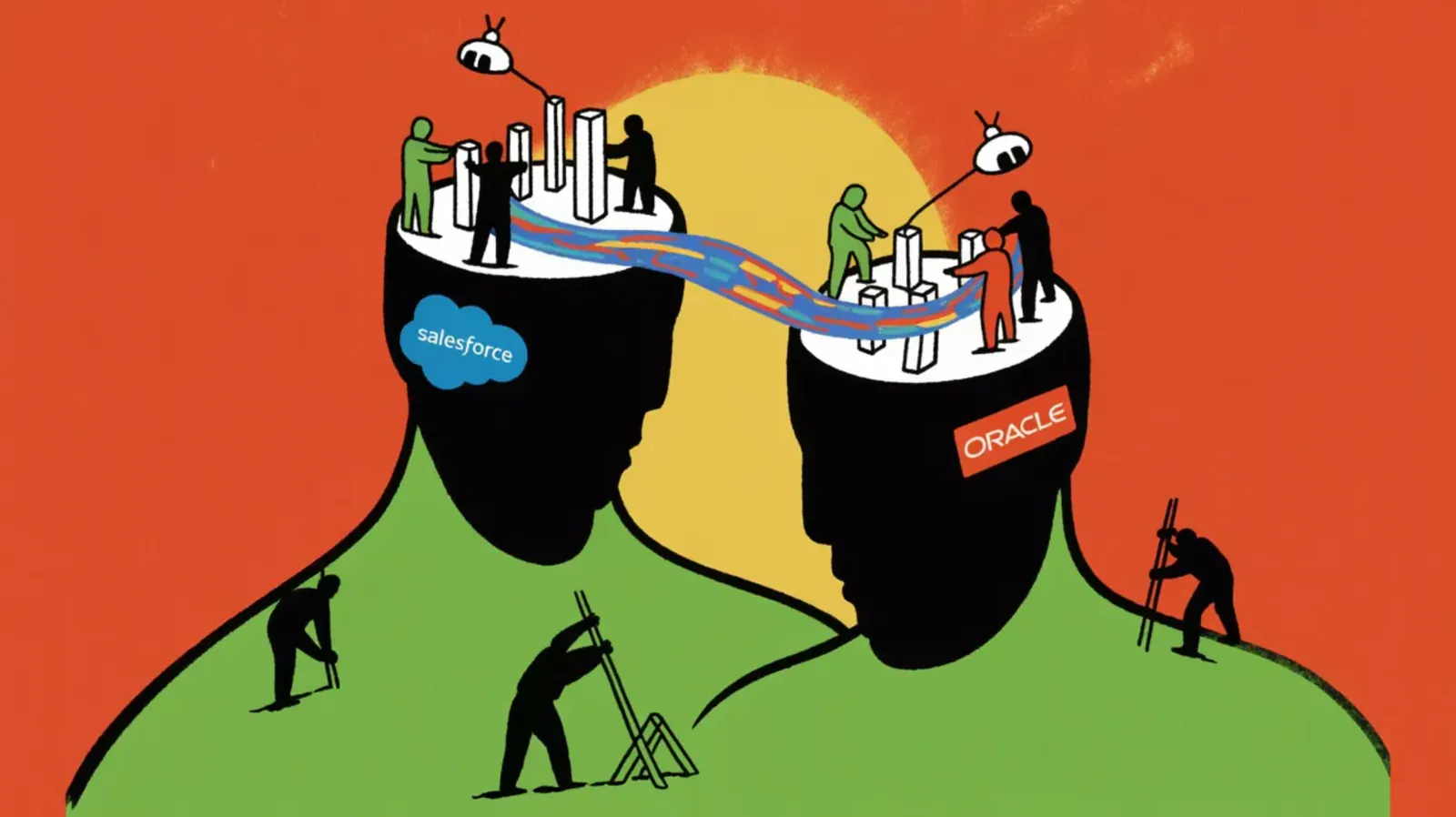
There's an idea going around on LinkedIn, in podcasts, in coffee chats and in investor presentations that goes more or less like this: thanks to artificial intelligence, anyone will be able to build their own custom software, with exactly the features they need and without paying a peso to anyone.
Therefore (the argument goes), the companies that sell software are doomed to disappear.
It's a tempting headline. It generates engagement. And for the most part, it's false.
Let me explain it with yogurt.
Yogurt, beer and other myths of "I'll just build it myself"
Making yogurt at home isn't hard. You buy milk, add a little plain yogurt as a starter, let it ferment for a few hours at a controlled temperature, and that's it: you have your own yogurt, with as much sugar as you want, any flavor you can think of and no weird dyes. It would be a total victory against the tyranny of big brands.
And yet almost nobody does it. At least not at a scale that keeps Danone, La Serenísima or Sancor up at night.
The same goes for brewing craft beer in the garage, baking sourdough bread or 3D printing. They're wonderful hobbies. Some people take them to truly impressive levels. But none of these practices ended up destroying its industry.
And the same thing happens with enterprise software.
What the new tools do (and what they don't)
Better tools raise what a dedicated person can achieve. We all agree on that. But by the same logic, they also raise what a dedicated team can achieve.
And a team 100% focused on building a product, with accumulated experience, proven processes and constant feedback from hundreds of customers, plays in a different league.
The question isn't "Can one person build their own CRM with AI?" Technically, yes.
The right question is: "Will that CRM be up to the needs of a company that is growing, bills millions and has real legal obligations?"
The answer, almost always, is no.
The mirage of vibe coding
Vibe coding (the idea of "I throw three prompts at an AI and I get my app") sounds great on paper. It feels like standing at the edge of a Copernican revolution: if all of us can create our own tools, who needs a software company?
But there's a trap here that deserves a calm look.
What the hype leaves out
The "now anyone can" narrative tends to skip a few uncomfortable details:
Code is just the tip of the iceberg: behind any enterprise software there are thousands of hours of validation, solved edge cases, tested integrations and thoroughly understood business processes.
Keeping something running is harder than creating it: starting a project with AI is relatively easy. Sustaining it, scaling it and evolving it for a decade is another story.
The time of whoever runs the business is worth money: if you're a director, manager or team lead, your hour is worth too much to spend it fighting with prompts while your competition moves ahead.
Legal responsibility can't be delegated to a chatbot: when something fails, someone has to answer for it. And "the AI built it" is not a valid answer in an audit.
Those four points, taken together, explain why serious companies are not replacing their critical systems with scripts generated in 15 minutes.
Making software is not just writing code
At Vantegrate we have been building enterprise applications for more than three decades.
Before the current wave of AI, before the cloud, even before many modern platforms existed. That mileage taught us something that vibe coding enthusiasts tend to overlook:
Building real software is not a programming exercise. It's an exercise in deep understanding of the business.
When a pure programmer tries to solve the collections flow of a perishable goods distributor, they run into a pile of rules that aren't in any manual. What if the customer pays with a postdated check?
What if the credit note has to be applied to a specific invoice?
The delivery run gets rescheduled when it rains. The sales rep earns commission only if actual collections exceed a threshold. The end-of-month volume rebate is calculated on the net amount and not on the gross.
You don't learn those details with a prompt. You learn them from years of talking to finance managers, delivery drivers, business owners and operations teams. If you want to know a bit more about how we think about this at Vantegrate, I invite you to read our story.
Hobby versus professional product
There is a huge gap between a tool you built on a Saturday afternoon and a serious enterprise solution. That gap is measured in variables like:
Transaction volume: processing 50 orders is one thing, and processing 50,000 without the system crashing or losing data is something very different.
Regulatory compliance: e-invoicing, tax authorities, accounting standards, personal data protection. A mistake here can be very expensive.
Operational continuity: who picks up when something breaks at 3 a.m. on a Sunday?
Audit and traceability: regulated companies need to show who did what, when and why.
Real scalability: what works with 10 users doesn't necessarily work with 1,000.
Each of those variables represents thousands of hours of invisible engineering. Hours that no hobbyist, however enthusiastic, is going to invest in a personal project.
What Francisco and I saw at Dreamforce
Some time ago, together with Francisco (my cofounder), we traveled to Dreamforce, the biggest event in the Salesforce ecosystem. And there, something became strikingly clear.
Thousands, thousands and thousands of companies are digitizing their operations on an already proven platform. They are not choosing to build something from scratch with AI.
They are choosing to build on serious enterprise infrastructure, with decades of testing, security certifications and a partner ecosystem that understands every vertical.
Why? Because the people who make these decisions are smart and have the right incentives aligned. They know the risk of going it alone is enormous and that the theoretical savings rarely materialize.
The invisible testing that holds everything up
Here is a fact few people mention: every Salesforce release goes through automated testing, modifications, regressions, performance validations and security reviews that no individual team or generative AI could easily replicate.
When a company decides to install a solution on a platform like that, it inherits its robustness. It is standing on the shoulders of giants. Building everything from scratch with a couple of prompts means giving up that advantage for no good reason.
That is why at Vantegrate we work with Salesforce and Oracle. Our artificial intelligence agents rely on proven enterprise infrastructure; they do not replace it. We get the best of both worlds: the power of conversational AI and the solidity of platforms with a long track record.
Where AI really changes the game
Let's be clear: artificial intelligence changes a great many things. I am not here to play the cocky skeptic. But it changes them in a different way from what the apostles of "now we're all programmers" preach.
Specialized agents, not generic ones
What we are seeing (and what we build at Vantegrate) are specialized agents. Agents that deeply understand a business process and automate it end to end, on serious platforms and with all the guarantees that a mid-sized or large company needs.
Some concrete examples:
Sellium automates sales on WhatsApp for sales teams that need to respond fast without sacrificing the quality of the conversation. It is not a generic chatbot. It is an agent trained to detect opportunities, qualify leads and move the sale forward.
Revio takes conversational marketing to another level, with agents that hold real conversations with prospects, nurture them with relevant content and hand them to the sales team at the right moment.
Metrix turns traditional BI into a conversational experience, where you ask your data questions in natural language and get actionable answers without needing to know SQL or waiting for the analytics team.
Each of these products is designed by teams that understand the specific problem they solve. They are not generic contraptions built in a rush. They are tools designed for specific industries and processes, with all the care that software operating at the heart of your company deserves.
Why do mid-sized and large companies keep buying software?
Think about this from the perspective of an operations manager, a CFO or a CIO. Their job is to maximize results with limited resources. What will they choose?
Option A: pay for a proven solution that is implemented quickly, comes with support, complies with regulations and lets them focus on their business.
Option B: build something with AI, spend months iterating, deal with unexpected bugs, take on legal risks, distract their team from its main focus and, eventually, end up buying a professional solution once they realize it does not scale.
The choice, for anyone who understands opportunity cost, is pretty obvious.
Time, risk and opportunity cost
Serious companies do not buy software because they don't know how to code. They buy it because they understand three fundamental things:
Time is money: every week it takes to digitize a process is money they stop earning or costs that keep piling up.
Risk is money (and reputation): a bug in production, a security vulnerability or a compliance error can cost far more than any annual license. That is why investing in platform security is not optional; it is central.
Focus is competitiveness: their teams are there to sell more, serve their customers better and grow, not to maintain internal software that any specialized provider could do better.
The "I'll build it myself" trap
There is a very common pattern in mid-sized companies: someone with good intentions builds an internal tool with the trendy technology. It works for a while. The company grows. The tool does not scale. That person leaves the company. Nobody understands how the system works. They end up throwing it out and buying a professional solution.
But along the way they lost two years. They lost opportunities. They lost customers. And, above all, they paid the most expensive cost of all: the cost of focus.
The right question is not "Who can build it?"
The right question is: "Who can sustain it, improve it and grow it for ten years?"
That question changes the whole analysis. Because building something is relatively easy. Sustaining it for years, with an evolving team, a growing customer base, changing regulations and a moving market, is far harder.
The value of a dedicated team
A team that is 100% focused on one product has structural advantages that no hobbyist can replicate:
It accumulates experience across hundreds or thousands of real use cases.
It maintains certifications and passes demanding audits.
It iterates based on constant feedback from diverse customers.
It invests in security continuously and systematically.
It guarantees support when something breaks (because, at some point, something always breaks).
It builds on years of learning in a specific industry.
That accumulated depth can't be compressed. A prompt doesn't generate it. Time, discipline and an obsession with doing one thing well generate it.
How does this translate into a business decision?
If you're evaluating adding artificial intelligence agents to your company, don't get seduced by the romantic idea of "building everything from scratch." It's like deciding to build your own refrigerator because there are now tutorials on YouTube. Technically possible. Economically and operationally, it's a bad idea.
What makes sense is working with partners who understand your industry, who rely on proven platforms and who have real experience building enterprise software. Partners who know when to apply AI and when not to. Who understand that technology is a means, not an end.
The next step
At Vantegrate we build artificial intelligence agents for mid-sized and large organizations that want to digitize processes without reinventing the wheel. We combine decades of enterprise software experience with the best AI technology available, all backed by platforms like Salesforce, which have already passed every test your business should never have to run.
If you want to see concretely how these agents can fit into your operation, you can book a demo and talk with our team. No commitment, no pressure, just so you can see with your own eyes how it works and decide if it's useful to you.
Enterprise software isn't going to die just because there are new tools to build it. On the contrary, the new tools will let teams focused on developing quality software build even better products. And those who understand that, those who bet on specialization, industry depth and sustained quality, will have an enormous advantage in the next decade.
The fear of "now anyone can do it" is a ghost. The reality is that very few will be able to, very few will want to and, above all, very few will sustain it over time. For everything else, there are professional teams with focus, experience and mileage. And that, today more than ever, is worth gold.