
Most organizations already use artificial intelligence, but almost all of the tools act as passive assistants that wait for instructions.
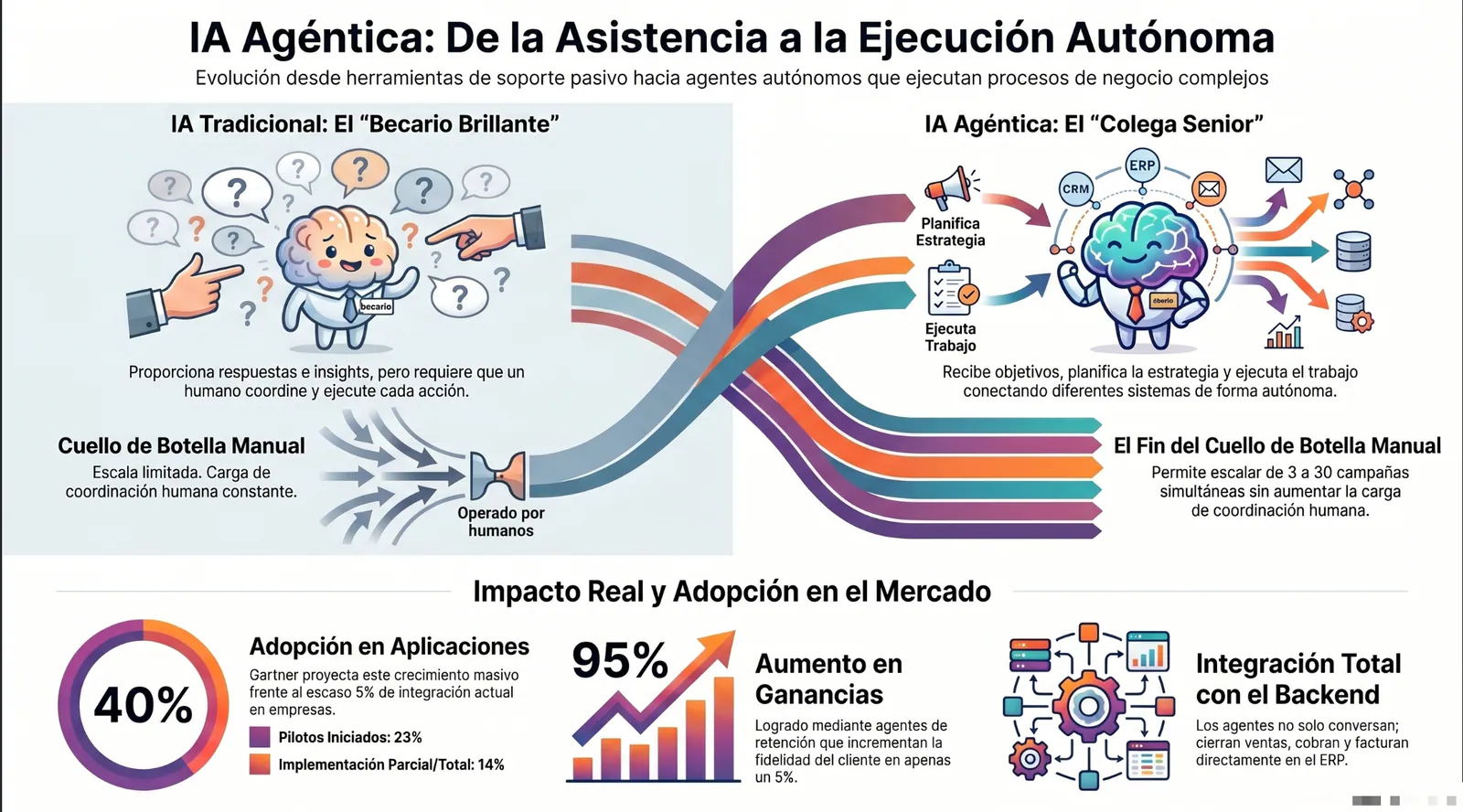
Someone always has to connect the dots, move insights between systems and trigger the next action. That manual coordination, manageable with three campaigns, becomes an unsustainable bottleneck when there are thirty.
That is why more and more technology, marketing and operations teams are exploring agentic AI: autonomous agents that can plan objectives, run complex workflows and coordinate across systems, without human intervention at every step.
The numbers back this trend: almost a quarter of organizations have already launched pilots with AI agents and 14% have started implementing them (Capgemini, 2025). Gartner projects that 40% of enterprise applications will include task-specific AI agents by the end of 2026, up from less than 5% in 2025 (Gartner, 2025).
In this guide we will walk through 10 high-impact agentic AI use cases and how autonomous agents are transforming campaigns, engagement and performance at enterprise scale. But first, a story.
A story of frustration (and why Sellium was born)
When we started Vantegrate, we noticed something recurring in our first meetings with mid-sized and large clients: entire teams were frustrated because the AI agents they tested could not truly interact with the company's ERP.
They wanted something that sounds simple, although in practice it is anything but simple:
For the agent to understand a complex product catalog, with variants, price lists and real-time stock.
For it to be able to close a sale in a WhatsApp conversation.
For it to collect payment without going through a thousand screens.
For it to then issue the invoice without a human having to copy and paste data.
And for all of that to be reflected automatically in the ERP, no matter whether it was Salesforce, Oracle or another system.
The alternatives on the market did not solve the problem: they were either attractive chatbots with no real connection to the backend, or rigid integrations unable to understand human language. That frustration was the origin of Sellium, our WhatsApp sales agent, designed to chat, sell, collect payment and invoice, integrated with the ERP. One conversation, the whole process resolved.
We tell you this because the use cases that follow make a lot more sense once you understand that what is truly disruptive is not that AI “answers questions.” It is that AI executes.
What is agentic AI, in plain English?
Before getting into the use cases, a quick, no-nonsense definition.
Traditional AI offers insights, predictions or automates specific tasks, but you are still the orchestra conductor. Agentic AI goes further: it plans, decides and executes complex workflows autonomously, adjusting course based on results. You define the objectives and limits, and the agent takes care of the operation.
In other words: traditional AI is like a brilliant intern who needs instructions, while agentic AI acts like a senior colleague who tells you: “I took care of it, here is what happened.”
Now, on to the use cases that are moving the needle the most.
1. Real-time campaign creation and optimization
Campaigns have stopped being “launches” and become continuous experimentation systems. And they solve two pain points that every marketing team knows by heart:
The demand for content per channel keeps growing. Each channel asks for its own pieces and formats.
The pressure to generate conversions is not easing either. Each campaign has to perform better than the last.
A well-configured agent turns a brief into assets, builds segments, launches tests across email, paid, site and social, and optimizes based on CTR, conversion and on-site behavior, all within the same cycle. 75% of marketers are already experimenting with AI or have fully implemented it, and high-performing teams are 2.5 times more likely than laggards to have it fully integrated (Salesforce, 2024).
2. Multichannel engagement without going crazy
Modern customers do not stay still. They talk by email, WhatsApp, web chat, push, social media and, sometimes (yes, still), by phone. Coordinating all of that by hand is a sure recipe for inconsistencies.
Some key data points to size it up:
73% of customers expect companies to understand their unique needs and expectations (Salesforce, 2022).
80% say the experience a company provides is as important as its products and services (Salesforce).
An engagement agent analyzes behavior signals (browsing, purchase intent, previous interactions) and determines the next best action. It can send an email after a product visit, send an SMS for an abandoned cart, or start a chat conversation when the user returns to the site, always keeping context throughout the conversation. That is the orchestration our conversational marketing agent, Revio, excels at.
3. Dynamic generation of creatives and content
Brands need hundreds of creative variations depending on audience, channel and format. Yet most teams still produce pieces manually and recycle them across segments, which lowers overall quality.
87% of marketers already use AI to create content or help create it (Ahrefs, 2025).
Those who use it publish 42% more content per month than those who don't (Ahrefs, 2025).
And 80% manually review that the generated content is correct before publishing it (Ahrefs, 2025).
What does a well-trained creative agent do?
It generates dozens of ad variations for different segments.
It builds dynamic landing pages based on traffic source or intent.
It writes product descriptions from the catalog, in real time.
When it receives engagement signals (time on page, conversions, CTR), the agent adjusts the message and automatically scales the winning creative. The difference from the traditional workflow is significant.
4. Churn prediction and retention agents
Churn almost never appears overnight. The signals (a drop in usage, fewer purchases, negative support interactions) usually show up weeks or months earlier. The historical problem has always been detecting them in time.
Acquiring a new customer costs between 5 and 25 times more than retaining an existing one, and increasing retention by 5% can raise profits by 25% to 95%, according to research from Bain & Company (Harvard Business Review, 2014). Retention is where the most value is.
A retention agent can monitor:
Behavior patterns (declining usage, shorter sessions).
Purchase frequency and average ticket.
Support tickets and sentiment in conversations.
Social signals and NPS.
When risk signals appear, the agent triggers personalized interventions: targeted offers, loyalty rewards, reactivation emails or proactive outreach from the customer success team.
5. Lead scoring and automated nurturing
Marketing teams generate more leads than sales can handle. And here's the cruel joke: many marketing leads never turn into sales, largely because they are not nurtured well.
A lead scoring agent leaves static scores behind and relies on an adaptive model. It analyzes page visits, email engagement, interest in specific products and purchase intent signals.
As new data comes in, it adjusts the score and triggers personalized nurturing sequences.
The result? Marketing spots hot prospects sooner and hands them to sales at the right moment. Not after they've already gone cold and started a conversation with a competitor.
6. Real-time customer insights analysis
Marketing teams swim in data: campaign metrics, CRM activity, product usage, social media conversations and support interactions. The real challenge is not collecting it, but turning that data into actionable insights in time.
A few numbers worth noting:
Companies that make intensive use of customer analytics are 23 times more likely to outperform their competition in acquiring new customers, and 9 times more likely in customer loyalty (McKinsey, 2014).
And those that lead in customer analytics are almost 19 times more likely to achieve above-average profitability than laggards (McKinsey, 2014).
An insights agent continuously monitors campaign platforms, the CRM, product usage data and social channels. It detects patterns (for example, growing interest in a product, sentiment shifts or segments that are cooling off) and presents them in an actionable way.
So, instead of monthly reports that arrive late, you get a constant flow of “this is happening now, this is what you can do.” That is the logic behind Metrix, our conversational BI: ask your data in natural language and get answers today to what you used to wait until Friday for.
7. Social listening and engagement with AI
Social networks are a constant waterfall of customer signals. Whoever listens early wins.
76% of consumers value brands that prioritize customer service and respond quickly, and 69% expect a response the same day they write on social media (Sprout Social, 2023).
On a network like X (formerly Twitter), the daily volume of posts makes it impossible to monitor by hand.
A social listening agent scans platforms, forums and communities 24/7 looking for:
Growing mentions of a product.
Sentiment shifts around the brand.
Conversations that signal purchase intent.
When the agent detects a relevant signal, it can suggest a reply, escalate to the team or (with well-defined guardrails) respond directly following approved messaging guidelines.
8. Customer journey mapping and orchestration
Customer journeys are rarely linear. Someone discovers the brand on social media, compares options in search engines, reads reviews, opens two newsletters and only then converts. Multiplied by thousands of customers, it's chaos.
A journey orchestration agent analyzes behavioral signals in the CRM, in marketing platforms, in website interactions and in purchase history, and automatically adjusts messages and touchpoints when behavior changes.
A concrete example
During the initial research stage, the agent sends educational content.
When the user enters the consideration phase, they receive comparison guides or success stories.
When purchase intent intensifies, a personalized offer is triggered or a call with the sales team is scheduled.
The key point: nobody is sitting there manually moving each lead between stages. The agent does it for you.
9. Autonomous experimentation and testing
Testing is one of those things everyone says they value, but few do it consistently. As a result, many teams run just a handful of experiments per quarter instead of optimizing continuously. When conversion rate optimization programs are executed properly, site conversions improve steadily.
An experimentation agent can:
Generate multiple variations of offers, messages, landing pages and journeys.
Launch tests across campaigns and channels simultaneously.
Monitor CTR, conversions, bounce rate and revenue impact.
Automatically scale winning variations and retire losing ones.
Instead of isolated A/B tests every so often, you have an optimization engine that runs all the time in the background.
10. Synthetic cohorts and scenario simulation
There is a classic dilemma in marketing: testing ideas on real audiences produces valuable learnings, but failed tests consume budget and can damage the customer experience.
This is where synthetic cohorts come in. An agent can:
Generate groups of simulated customers based on behavioral data, demographics and historical campaign responses.
Model how those cohorts might respond to different offers, messages or pricing strategies.
For example, an agent can simulate the performance of a new promotion across different segments, estimate conversions and identify the most promising scenarios before allocating budget. It's like a wind tunnel for campaigns: you test everything in simulation before going out on the track.
And the back office? The quiet but enormous use case
While everyone talks about marketing and sales, there is an area where agentic AI is also transforming processes: internal operations. Processing of invoices, contracts, purchase orders, tickets and regulatory reports. High volume, clear rules and repetitive tasks: the ideal scenario for autonomous agents.
That's why we developed Arconte, our document processing agent: it reads, classifies, extracts key data and sends it to the right system. What would take a team days, an agent resolves in minutes, with full traceability.
How to approach agentic AI adoption without hitting a wall
Agentic AI moves AI from assistance to execution. Instead of generating ideas or reports, agents analyze signals, make decisions and act across marketing, sales or back office workflows. Companies already run hundreds of campaigns and experiments in parallel: manual coordination at that scale simply doesn't scale.
A few recommendations to get started right:
Start with narrow but high-impact workflows. Experimentation, customer engagement or analytics are usually good starting points because real-time signals already exist.
Connect the agents to the systems that matter. CRM, campaign platforms, ERP, product data. If the agent doesn't see the right data, it will make wrong decisions.
Define clear limits: what the agent can do autonomously, what requires human approval and what it should never modify.
Measure real results: conversion lift, improved retention and campaign speed. Don't stop at "AI usage" metrics.
Consider security from day one. An agent with access to critical systems requires the same level of rigor as any production integration. Our platform security page details how we approach it.
Frequently asked questions
How does agentic AI differ from traditional AI or automation?
Traditional AI offers insights, predictions or automates a specific task, but it needs a human to turn those outputs into action. Agentic AI executes multistep workflows on its own: it plans actions, interacts with systems and adjusts its decisions based on results. It's the difference between having a map and having a copilot.
What is the biggest benefit for D2C marketers?
Being able to run most of the marketing and retention engine with very little manual coordination. Agents monitor signals, launch campaigns, test variants and optimize performance without pause.
That frees the team to focus on strategy while the system takes care of execution. The result? More experimentation, better personalization and concrete improvements in ROI, retention and customer lifetime value.
Is agentic AI only useful for marketing and customer service?
Not at all. Marketing and customer engagement are the most visible areas of adoption, but the approach applies to operations, IT support, human resources, cybersecurity, finance and logistics. Any workflow that involves signals, decisions and repeated actions is a candidate.
In fact, we already have last-mile logistics cases running with Trazzo.
How long does it take a mid-sized or large company to see results?
It depends on the maturity of your data and on integration with your existing systems. Well-scoped pilots usually show measurable results within a few weeks: a conversion lift, a reduction in response times and better retention performance. The key is to choose a use case with clear metrics from the start.
Do I need Salesforce or Oracle to implement agents?
It's not a requirement, but it helps a lot when you already have a consolidated CRM or ERP. At Vantegrate we work closely as a Salesforce partner, which lets agents operate on the company's source of truth, without "adding another platform" to the stack.
If you want to see how all this translates to your business, book a demo with our team and we'll show you live how an agent connected to your real operation works. No endless slides, just concrete cases.