
I gave a mentorship session at Talento Tech and opened one of the talks with this question: if I had to start in the Salesforce ecosystem today, how would I look for a job? I put the material together with 2026 market data and a concrete plan, and I decided to make it public in case it helps someone else.
The short answer is that I would not do what everyone did five years ago. The market changed, and anyone who goes out looking with the same generic profile as always hits a wall.
First, the uncomfortable truth
According to the 10K Salesforce Talent Ecosystem Report 2026, global demand for Salesforce talent fell 13%. There are about 3.4 certified people for every opening, and developer was the only role with falling demand (−12%) while supply grew 20%.
There are jobs. But not for the generic profile.
Demand didn't die: it moved
Looking at the year-over-year change in job posting mentions, the map is crystal clear: Revenue Cloud +134%, Health Cloud +110%, Agentforce +63% and Data 360 +10% globally (+92% in the US). On the other side, Sales Cloud −13%, Service Cloud −21% and Marketing Cloud −28%.
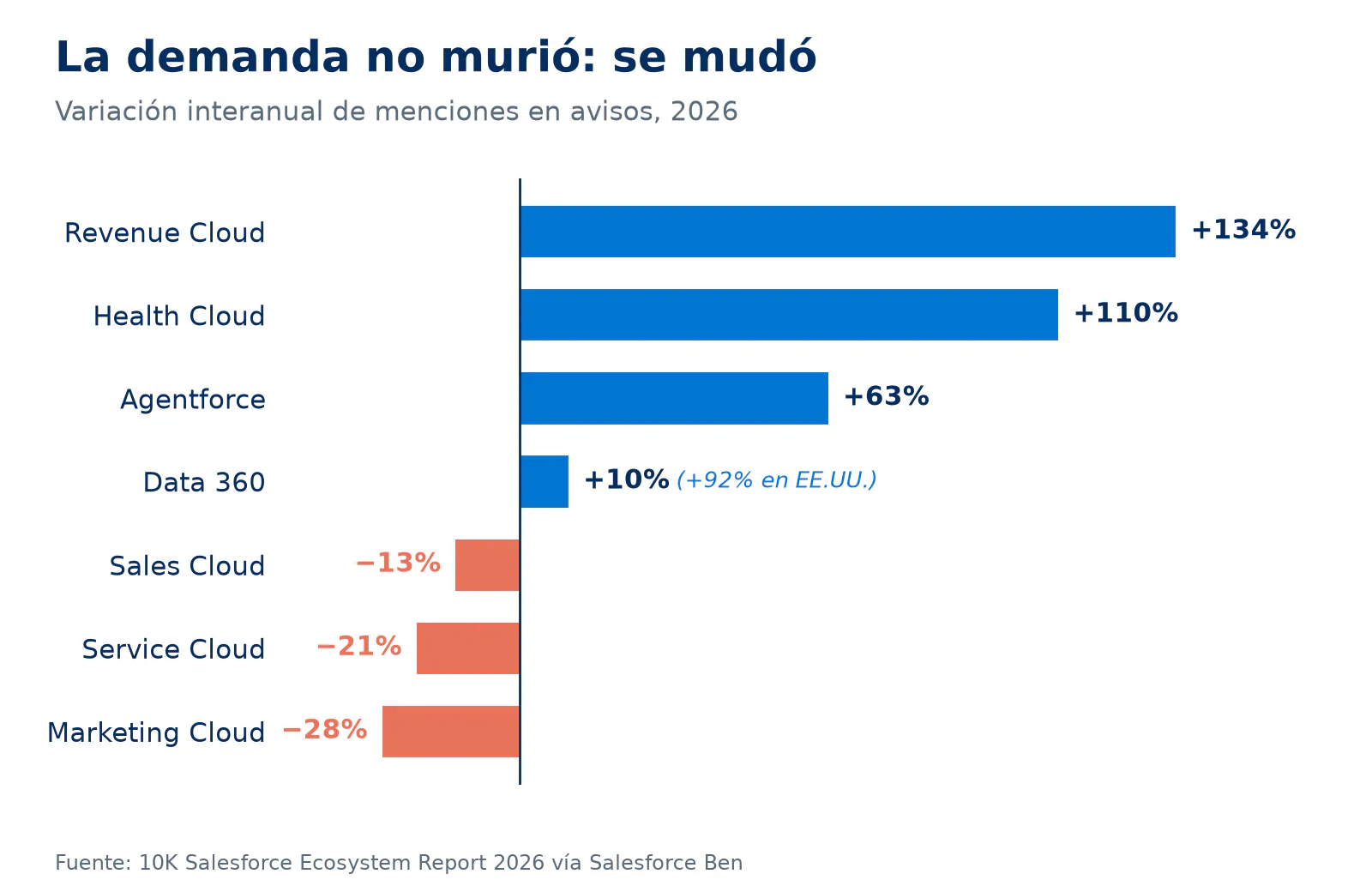
If I were starting today, I would bet where there are open searches and few people who know the topic.
Where I would place my bets
Agentforce. It's the fastest-growing skill and already shows up in 9 out of every 100 postings. The gap is that many projects stay at the pilot stage: there's a shortage of devs who can take agents to production with actions in Apex, Flows, clean data and testing. I would get the Agentforce Specialist and Platform Developer I certifications, learn Topics, actions and Prompt Builder, and build a real agent in a Developer Org to show it off.
Data 360 (formerly Data Cloud). Without data there is no agent. It's the newest product and almost nobody has production experience. I would dig into data modeling, identity resolution, segments, ingestion and Zero Copy, and aim for the Data Cloud Consultant certification.
Revenue Cloud, CPQ and industries. Complex pricing, subscriptions and billing are learned slowly, which is why almost nobody knows them. I would learn quote-to-cash, API integrations and MuleSoft, and I would pick an industry (healthcare or government hold up demand better) to understand how its business works.
And I would add two cross-cutting skills: integrations with APIs and MCP (Agentforce is opening up to external agents) and DevOps with testing, which is already a pillar when it comes to hiring.
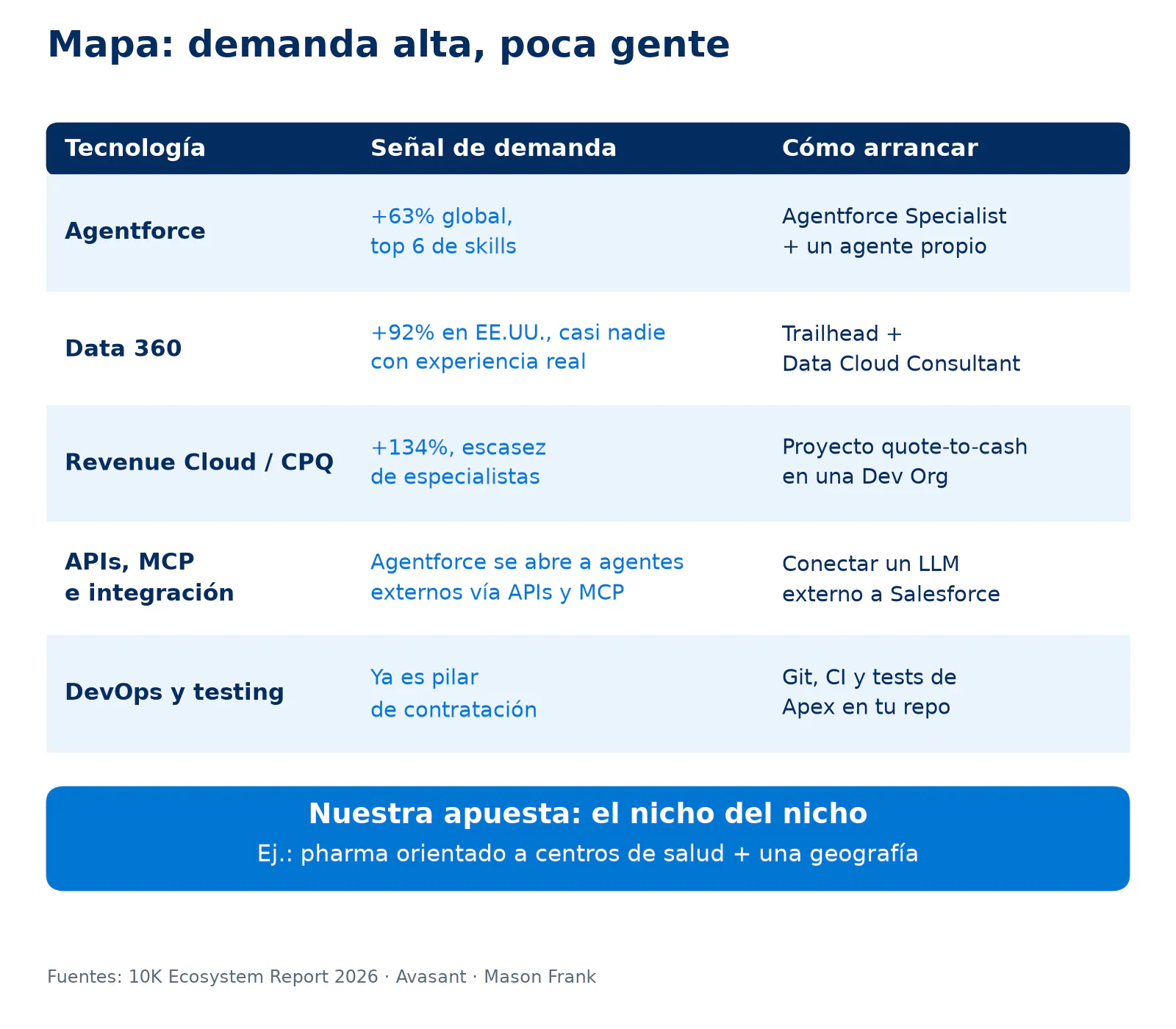
Our big bet: the niche within the niche
Here is our own opinion, not a data point from the report: we believe Agentforce and Data 360 will become commodities. Today there is a gap because they're new, but soon there will be a lot of certified people and knowing them will be the baseline, not the differentiator.
That's why we strongly recommend going to the niche within the niche. Saying "I know Health Cloud" isn't enough: what sets you apart is something like pharma oriented to health centers, understanding how laboratories, institutions and doctors relate to each other, and how that gets modeled in Salesforce. And if you also add a geography (the regulations, the players and the way of working of a specific country or region), even better. There the competition is minimal and whoever knows the field is hard to replace.
Agentforce and Data 360 still add value, but as tools in service of that niche, not as the specialty itself.
My advantage from Argentina
My market would be the US, working from here. Companies there are hiring more and more in the region because we share a time zone. The biggest multiplier is conversational English, so I would work on it from day one, and I would target partners and consultancies that do nearshore work and remote searches with compatible hours.
My 90-day plan
Days 1 to 30, choose and get organized. A concrete niche (industry, sub-vertical and, if possible, geography), Platform Developer I if I don't have it yet, a Developer Org and Trailhead modules on the topic.
Days 31 to 60, build something real. A project designed for that niche (an agent or an integration that solves a problem in that industry), code on GitHub with a good README and a recorded 2-minute demo.
Days 61 to 90, go show it. A second certification in the specialty, the demo published on LinkedIn and 5 messages per week to people who hire in that niche.
Making myself visible
Knowing isn't enough: they have to find you.
LinkedIn as a storefront. According to LinkedIn data, a profile with a photo gets up to 21 times more views, and turning on Open to Work doubles the chance that a recruiter writes to you. The headline needs searchable keywords ("Salesforce Developer | Health Cloud | Pharma | Apex"), not "looking for new challenges". I would pin the demo, the GitHub and the certifications in the featured section, and post once a week about what I'm learning.
Talk to the decision maker, not the portal. The ecosystem has a record 4,247 partners (+14%), and the growth comes from small firms. I would write to founders and CTOs of small and mid-sized partners, delivery managers and specialized recruiters. A short, personalized message, showing something you've built and not asking for a job right away. Something like this:
"Hi Martín, I saw that [Partner] is working with health centers. I built an agent that [solves X] in my Dev Org, and here's the 2-minute demo: [link]. If you ever add devs, I'd love to chat for 15 minutes. Thanks!"
If they don't reply, follow up once a week later.
A résumé that reads in 10 seconds. One page, in English if I'm aiming abroad. At the top: role, LinkedIn, GitHub and Trailhead; certifications clearly visible; the keywords from the job posting, because filters search for them. Every line with a result, not a task: instead of "Developed triggers and LWC components", something like "Built an Agentforce agent with 3 Apex actions that answers order-status questions. Demo and code on GitHub."
The hardest part: turning on the camera
Embarrassment costs more than making a mistake. I would record demos, because two minutes showing something you built is worth more than any paragraph. I would speak at communities, meetups and classes. And I would prepare for video interviews: good lighting, good audio and eye contact with the camera, which is already part of the evaluation.
If you're just getting started, join the Spanish-language Salesforce community on WhatsApp: that's where we share job searches, questions and demos.
Sources: 10K Salesforce Ecosystem Report 2025 and 2026 via Salesforce Ben, Mason Frank, Avasant and data published by LinkedIn.