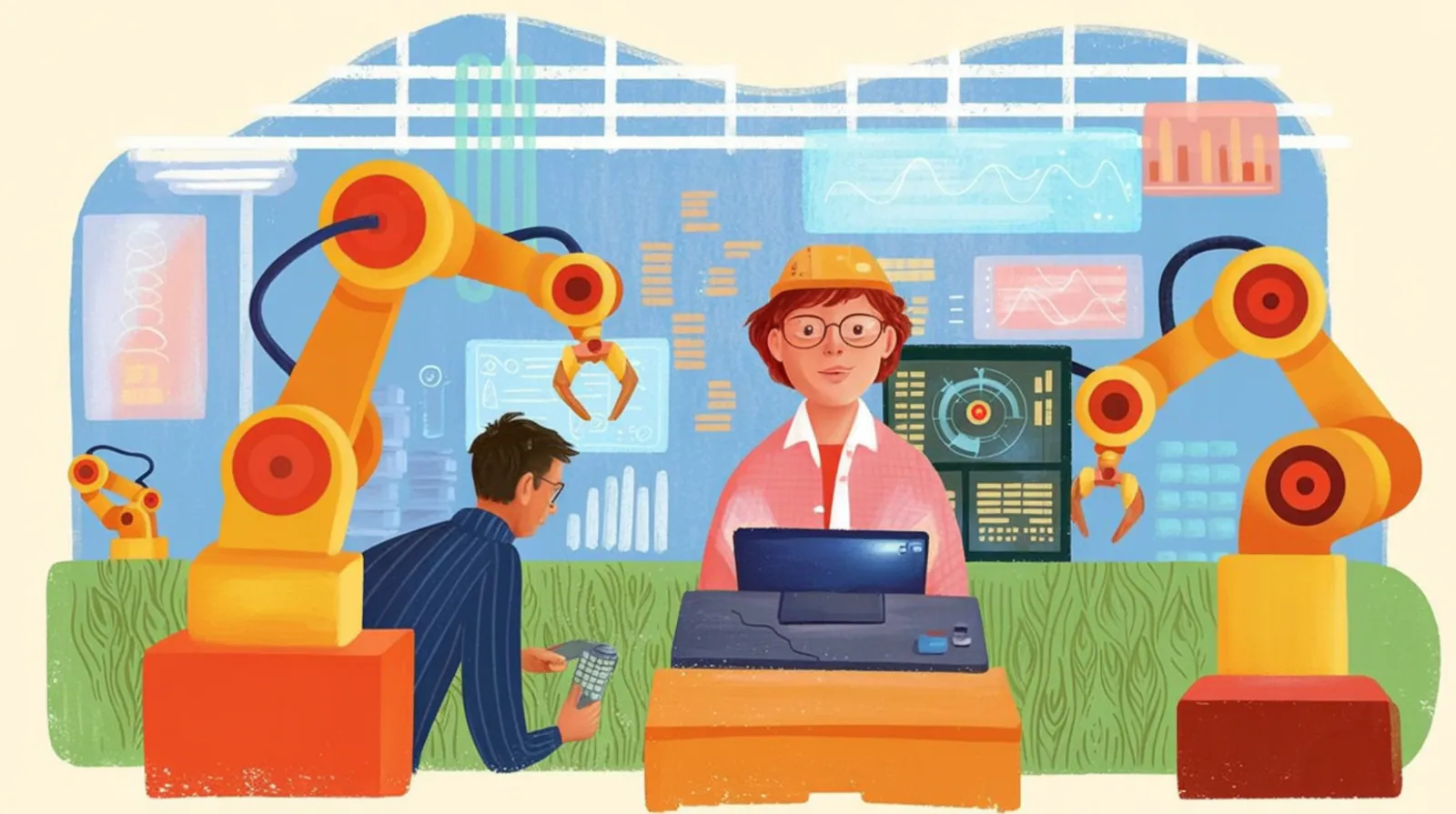

If you're still debating whether your company needs an enterprise artificial intelligence strategy, you're already late. But you can still get results if you act now.
AI is no longer a lab experiment. It's the muscle that separates the organizations that grow from the ones that barely survive. This isn't about adding a chatbot or asking a generative model to write an email. It goes much further: autonomous AI agents, specialized models and scalable infrastructure working as a coordinated system.
Now that we understand the big picture and what's at stake, let's move on to a practical roadmap. Here is the roadmap we use to design AI strategies in mid-sized and large organizations. This guide is based on what actually works when digital transformation becomes a tangible reality.
Why enterprise AI is no longer optional
The numbers are compelling. The studies measured:
78% lower cost per invoice in the top 20% of accounts payable teams, with lower costs and shorter cycles, which rely more on e-invoicing and automation, compared with the rest (Ardent Partners, 2024)
14% more inquiries resolved per hour in support teams working with a generative AI assistant (NBER, 2023)
Tasks completed more than 25% faster, and with more than 40% higher quality, by consultants who used GPT-4 (Harvard Business School)
15% lower logistics costs at companies that adopted AI early in their supply chain, compared with their slower competitors (McKinsey, 2021)
These numbers aren't achieved by installing models and hoping for miracles. They come from strategic integration: each piece, whether agents, models or infrastructure, forms a coherent ecosystem.
Companies that take this approach are already redefining industries. Those that don't will soon watch their competitors move to new levels of competence.
The three pillars of a solid enterprise AI strategy
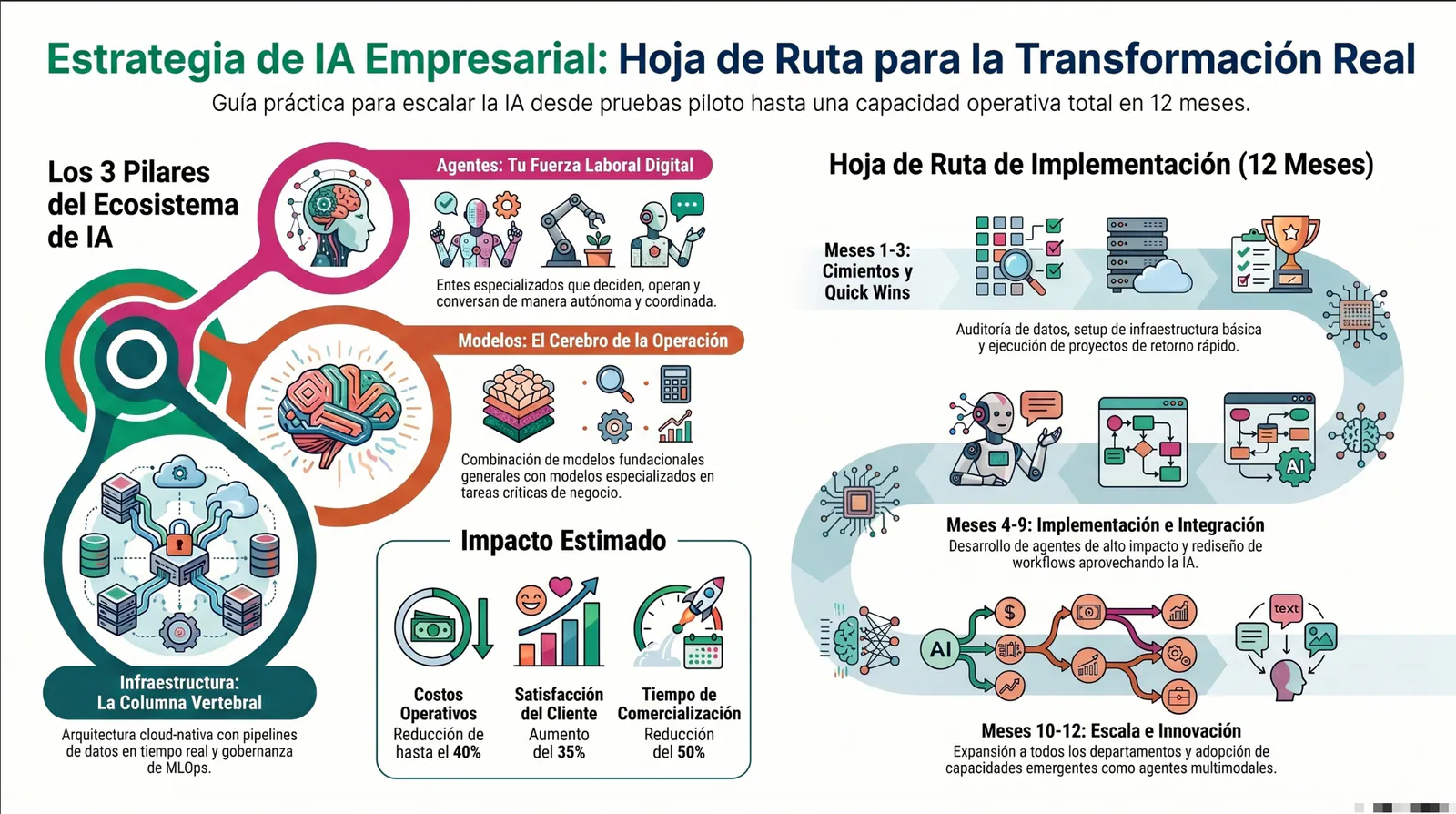
A solid strategy rests on three pillars. If one is missing, the building collapses.
1. AI agents: your new digital workforce
Think of artificial intelligence agents as highly specialized employees who don't sleep, don't complain and get better every day. Each one has a specific mission and, most interesting of all, works as a team.
Some of the most common roles:
Decision agents. They process market data, detect opportunities and assess risks. They are the analysts your board always wanted to hire but could never afford at that scale.
Operational agents. They coordinate workflows, allocate resources in real time and detect bottlenecks before they turn into a crisis. Logistics, operations and the supply chain are their natural territory.
Conversational and customer service agents. They respond 24/7, remember each customer's history, personalize every conversation and escalate to the right person when needed. Here we're talking about things like conversational sales over WhatsApp, where a well-trained agent can move the needle for the business dramatically. If you want a concrete example, Sellium is an AI agent designed for exactly that: selling over WhatsApp with the intelligence of your team's best sales rep, but at scale.
The magic isn't in each agent on its own, but in the coordination between them: a decision agent detects an opportunity, an operational agent reallocates resources and a customer service agent notifies the stakeholders. It all happens in seconds, without endless meetings.
2. AI models: the brain behind the agents
Agents are the arms. AI models are the brain. And, as in the human brain, there isn't a single type: there are specialized regions for different tasks.
Foundation models. These are the all-rounders. They process natural language, generate text and solve creative problems. They are the base on which almost everything is built.
Specialized models. This is where the magic happens. Models trained to detect banking fraud, optimize supply chains, predict customer churn or automate the processing of accounting documents. They do one thing, but they do it extremely well.
Hybrid models. They combine the best of both worlds: the flexibility of foundation models and the precision of specialized ones. They are the ones that end up solving the most complex workflows in day-to-day business.
The life cycle of a model in production has three stages: training, inference and continuous learning. If your team doesn't have a defined process for all three, you'll end up with a model that is brilliant in the first month and obsolete by the sixth.
3. Infrastructure: the invisible backbone
Your agents and models may be sophisticated, but without solid infrastructure they go nowhere. It's like having a Ferrari with no road.
Good AI infrastructure has three non-negotiable components:
Cloud-native architecture: elastic scaling, global deployment, optimized costs
Data pipelines: real-time ingestion, cleaning, validation, secure storage
MLOps platform: model monitoring, version control, automated deployment
Everything must meet the highest security standards. You will be processing sensitive data. Security is not an extra; it is fundamental.
How they work together: the symphony of enterprise AI
That is the key point: an AI strategy is not a collection of components, but an orchestra that needs a score to stay coordinated.
Simplified, the flow looks like this:
Data preparation → the cloud infrastructure feeds clean, real-time pipelines
Model deployment → foundation models for general tasks, specialized models for niches
Agent orchestration → agents execute, decide, communicate
Continuous optimization → MLOps monitors, feeds back, fine-tunes
Scaling and governance → the infrastructure grows, ethical frameworks are applied
When these five steps are aligned, something powerful happens: AI stops being a project and becomes an organizational capability. Something your company is, not something your company has.
Your roadmap: from pilot to full deployment in 12 months
Strategy takes shape through execution. Here is a structure proven over twelve months, organized into three consecutive phases.
Phase 1: Foundations (months 1 to 3)
Before you build anything, you need to understand what you have and what you are missing.
Capability audit. How clean is your data? Which processes could quickly benefit from AI? Is your team culturally ready to bring in intelligent agents?
Identifying quick wins. Those cases where ROI arrives fast and proves the value of the bet. Automating ticket classification, speeding up post-sale support, optimizing invoice processing.
Infrastructure setup. Cloud, pipelines, security. The foundation. Without it, the rest is a castle in the air.
Team building. Data scientists, AI engineers, business people who understand the potential. And broad training for the rest of the organization: AI is not just a job for the technical team.
Phase 2: Implementation (months 4 to 9)
This is where you start building and deploying.
Agent development. Start with high-impact cases: customer service, automation of repetitive processes, predictive analytics. Iterate fast. Measure everything.
Model integration. Combine foundation models with specialized developments. Set up monitoring systems from day one.
Process optimization. This is key: it is not about layering AI on top of broken processes. It is about redesigning workflows to take advantage of what AI can do.
If in this phase you need to integrate your AI with platforms like Salesforce, make sure you work with partners who already have experience in the ecosystem. As a certified Salesforce partner, I can tell you that deep integration with the CRM is what separates successful AI projects from the ones that stay as nice demos with no traction.
Phase 3: Scale and innovation (months 10 to 12)
If you made it this far, you have already proven the value. Now it's time to expand.
Expansion. The more departments, the more use cases and the more automation. HR, marketing, supply chain and finance: all of them have processes that can be strengthened.
Optimization. Model retraining, better coordination between agents, lower latency and costs. This is where the difference between “having AI” and “operating with AI” starts to show in your margins.
Innovation. Here you explore advanced generative AI, multimodal agents and emerging capabilities. This is where you stop “implementing AI” and start to create competitive advantages your competitors won't be able to copy easily.
Common traps you should avoid (and how)
Working on this for years has left me with a few useful scars. Sharing the most important ones seems more valuable to me than pretending everything is rosy.
Trap 1: Trying to do everything at once
The classic mistake: defining 15 use cases at once, spreading resources thin and losing focus. The result: nothing fully works. Lots of busy people, little measurable impact, zero trust for the next round of investment.
The way out: pick one or two high-impact cases. Get the win. Capitalize on what you learned. Then scale. Strategic patience always wins.
Trap 2: Ignoring change management
AI is not just a technical project. It is a human project. And humans, when they feel something threatens their job, resist. Sometimes openly, sometimes in much subtler and more dangerous ways.
The way out: communicate early and often. Explain the “why.” Invest in training. Show how AI frees people from tedious tasks and lets them do their work more strategically. Make sure your teams feel amplified, not replaced.
Trap 3: Underestimating data quality
Brilliant model + dirty data = toxic predictions. There is no way around it. If your data is messy, your AI will be too. And the worst scenario is not that it fails: it is that it fails elegantly and nobody notices until it is too late.
The way out: establish data governance before you touch the first model. Clean. Validate. Monitor continuously. It is less glamorous than deep learning, but it is the foundation of your success.
The future: toward real human-AI collaboration
Looking a little further ahead, there are three trends worth keeping on your radar.
Autonomous AI systems. Agents that learn, adapt, and improve on their own. That allocate resources dynamically. That anticipate problems before they happen. This is already happening: it's not science fiction.
Real human-AI collaboration. Not replacement, but augmentation. Natural conversational interfaces. Assisted decision systems in which the human keeps the final say, but is backed by deep analysis. Employees focused on strategy, while AI handles the routine.
Ethical AI development. Transparency, fairness, explainability. As AI gets involved in more critical decisions, ethical governance becomes non-negotiable. This will be a brand differentiator, not a regulatory burden.
The time to act is now
If I had to sum it all up in a few lines, I would say this:
Enterprise AI is not just another tool. It is a new way of operating.
The cost of not acting already exceeds the cost of getting started.
The formula that works: start small, think big, scale fast.
It's not a destination. It's a continuous journey of iteration and improvement.
The organizations that take this challenge seriously today, not with fear, not with hype, but with a plan, will define the industries of 2030. Those that keep putting it off will simply disappear from the map or be reduced to secondary roles in their own markets.
The good news is that you don't have to walk this path alone. There are strategic partners whose job is precisely this: helping mid-sized and large organizations design, implement, and scale AI strategies that deliver real results.
If you want to explore how to apply this roadmap to your organization with a team that combines deep expertise in AI agents with native integration into platforms like Salesforce and Oracle, you can book a demo and we'll talk about your specific case.
The future is not going to wait until you're ready. You're better off getting ready now.