
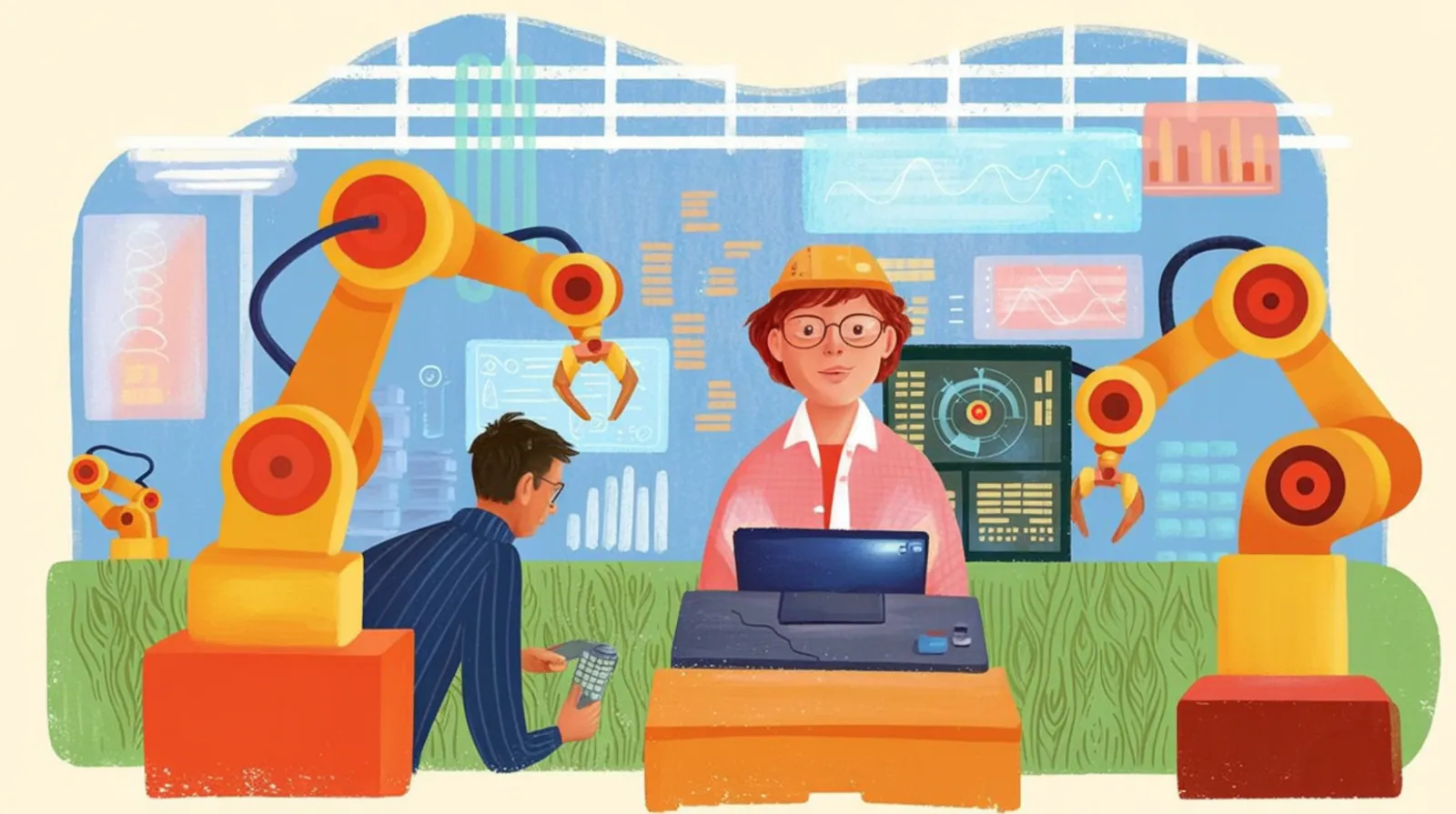
For many, many years, automating a factory meant programming machines to repeat the same task without rest. Those machines were fast and precise, but also blind: they did exactly what they were told, and not a bit more.
Today the picture is different. Artificial intelligence in manufacturing adds something to that brute force that didn't exist before: the ability to observe, learn and decide in near real time.
The result? It's not just a faster plant. We're talking about a smarter plant, one that can anticipate failures before they happen and adjust production without anyone having to push a button.
In this guide you'll learn what this technology really is, what concrete benefits it offers and, above all, how to take the first steps without getting overwhelmed.
The idea is simple: by the time you finish reading, you'll know exactly where to start.
What AI applied to production really is
Let's start with the basics, without unnecessary jargon. AI in manufacturing uses machine learning (machine learning) and deep learning (deep learning) algorithms to analyze large volumes of data and detect patterns that the human eye would never catch.
Once it finds those patterns, AI takes action. It can complete tasks, automate entire processes or deliver recommendations your team uses to make better decisions.
To make it clearer, imagine an operator with forty years on the job who never gets tired, never gets distracted and remembers every detail of every shift. Connected to thousands of sensors, that is what AI does on the plant floor.
The difference between automating and adding intelligence
Here is a key distinction that many overlook. Traditional automation follows fixed rules: if A happens, do B, always the same.
AI, on the other hand, learns from data and improves on its own over time. It doesn't need someone to explain every possible scenario, because it discovers the answers by itself.
It's the difference between a calculator and an advisor. One does the math; the other understands the context and tells you what to do.
Why data is the real fuel
No smart factory works without a solid base of quality data. Machines, sensors and systems generate information every second, and all the value is hidden in there.
The historical problem was that this information lived in separate islands. Information technology (IT) systems went one way and operational technology (OT) teams went another, never talking to each other.
When those two worlds are unified on a single platform, something powerful happens. Management is centralized, operations are simplified and costs drop noticeably.
Even better: with integrated data, AI can cross-reference information from the entire operation to monitor more precisely, optimize more and generate reports that help you decide better.
Think of a typical plant case. A vibration sensor detects a minimal anomaly, the system cross-references it with the maintenance history and, within seconds, raises an alert before the problem becomes serious. If you want to see the same logic applied to towers, pipelines and power grids, check out how AI is changing the energy sector.
This is where a tool like Metrix, our conversational business intelligence solution, changes the rules. Instead of fighting with dashboards full of charts, you ask a question in natural language and get a clear answer instantly.
The benefits that really move the needle
Talking about AI sounds nice, but in the end what matters are tangible results. These are the most concrete benefits already transforming the manufacturing sector across the region.
More safety for your people
Some tasks are dirty, repetitive or downright dangerous. AI-powered robots can take them on and keep people away from the risk zone.
Computer vision systems also watch the environment in real time. They detect unsafe conditions or unauthorized access to restricted areas before anything goes wrong.
The benefit is twofold. You protect your team and, at the same time, you improve productivity and the satisfaction of the people who work in the plant.
More efficiency and far less waste
AI optimizes processes to increase output (what the industry calls throughput) without adding more shifts or more machines. Every available resource starts to perform much better.
It also monitors energy and material use and suggests adjustments to reduce waste. That doesn't just lower costs: it contributes directly to the company's sustainability goals.
Predictive maintenance: goodbye to surprises
Unplanned downtime is the nightmare of every plant manager. According to an estimate by two executives at Interstates, an industrial integrator, published on Automation.com, every factory loses at least 5% of its production capacity to downtime, and many lose up to 20% (Automation.com, 2011).
Predictive maintenance completely turns the tables. AI analyzes the behavior of each piece of equipment and tells you when it's about to fail, so you can fix it before the whole line stops.
This is pure gold for companies that run high-value industrial machinery. In those settings, every hour of stopped production can cost a real fortune.
Design and prototyping at a different speed
AI also speeds up the creative side of the business. With computer modeling, simulations and digital twins, teams go from idea to prototype in a fraction of the time it used to take.
Quick pause: what is a digital twin? It is, basically, an exact virtual copy of a product or a machine that exists in the real world.
It lets you test thousands of scenarios on screen before spending a single peso on physical materials. If something fails, it fails in the simulation and not on the production line.
Use cases that are already working
The theory sounds good, but let's look at where all this is applied day to day. The use cases of AI in manufacturing fall into four main families.
Shop floor automation
The most advanced plants already have several types of robots working side by side with people. There are autonomous mobile robots (AMR), automated guided vehicles (AGV) and cobots, which are collaborative robots designed to assist people, not replace them.
These machines handle welding, assembly, material transport and even warehouse safety. The goal is always the same: speed up processes, gain efficiency and protect your people.
Process automation and quality control
This is where AI really shines: quality inspections. It can check products along the entire chain (before, during and after production) to ensure consistency and catch defects instantly.
This is no small matter: the cost of quality (preventing, detecting and correcting defects) is a number few companies have a clear grasp of. According to ASQ, only 31% of the professionals it surveyed feel they fully understand its impact on financial results (ASQ, 2025). Reducing those errors has a direct impact on profitability.
AI also takes care of the paperwork nobody wants to do by hand. Processing purchase orders, invoices and quality control reports is the ideal job for a document automation solution like Arconte, which reads, classifies and loads the information without errors or delays.
A much more resilient supply chain
AI combines data analysis with computer vision to project market trends and anticipate risks. This makes the supply chain more resilient, agile and customer-centered.
For example, it helps you forecast demand accurately and plan maintenance stops based on actual equipment usage. For your entire logistics operation to flow, that kind of anticipation is worth its weight in gold.
The last mile, which tends to be the most expensive and tangled stage of all, also benefits a lot. Tools like Trazzo optimize routes and deliveries in real time, so the product arrives faster and at a lower cost.
A customer experience that builds loyalty
Customers are the heart of any business, and industry is no exception. AI lets you personalize every communication and capture preferences, patterns and history to improve your products down the road.
On the sales side, a WhatsApp sales agent like Sellium handles inquiries and moves deals forward 24 hours a day, without letting a single lead slip away. For campaigns, the conversational marketing from Revio builds tailored messages that truly engage.
The myths that still hold many companies back
Before moving forward, it helps to dismantle a few beliefs that scare people for no reason. They are repeated myths that, up close, don't hold up.
"AI is going to replace all my employees"
It's the number one fear, and the reality is very different. AI is designed to empower the human team, not wipe it off the map.
What it does is take the boring and dangerous tasks off your hands. That way your people focus on what really adds value: solving problems, improving processes and innovating.
"This is only for big multinationals"
Completely false. Modern solutions are modular and scalable, which means you start with what you need and grow little by little.
A mid-sized company can start with a single, well-chosen use case. You don't need the budget of a giant corporation to see real results.
"It's too expensive and complicated"
Another myth worth burying. The cost of doing nothing (defects, stoppages, waste) is usually much higher than the cost of adopting the technology.
And with the right partner, complexity stops being your problem. Implementation becomes a guided, step-by-step process, without surprises.
How to measure whether AI is working
Implementing is one thing, and knowing whether it's worth it is something very different. For that you need clear metrics from day one.
Before you start, take a snapshot of the current state (what's called a baseline). Without that starting point, it's impossible to know how much you improved.
These are some indicators worth tracking closely:
Machine downtime: how many hours production stops and why.
Defect rate: what percentage of products come out with faults.
Overall equipment effectiveness (known as OEE): a measure that combines availability, performance and quality.
Energy and material consumption per unit produced.
The rule is simple: if you don't measure it, you can't improve it. These numbers tell you, plainly, whether the investment is paying off.
How to get started without burning out
After reading all of this, you might think that adopting AI is a massive project. The good news is that you don't have to do it all at once.
The secret is to start small and stay focused. Pick one concrete, measurable problem (for example, reducing the downtime of a critical machine) and build from there.
The second step is to get your house in order internally. Connect your systems with robust platforms like those in the Oracle ecosystem or the main enterprise software platforms that thousands of companies around the world already use.
And there is one point you can never set aside: security. All that sensitive information needs top-level protection, so it pays to understand how platform security works before taking any step.
The third step is to choose a good partner for the road. An experienced partner saves you months of trial and error and helps you avoid the potholes where poorly planned projects fall.
The future: factories that learn on their own
What comes next is even more interesting than what we already have. AI has the potential to touch almost every corner of production and make it more automatic, intelligent and efficient.
There are three major trends worth following closely:
Empower the human team instead of replacing it, with cobots and tools that improve safety, productivity and job satisfaction.
Shorten time to market, compressing development and production cycles to respond faster.
Design smarter plants using computer vision and sensors to optimize the layout of the physical space.
The underlying idea is very clear. AI didn't arrive to take people out of the equation, but so they can focus on more valuable, creative and safer tasks.
The first step is closer than you think
Transforming your operation doesn't start with a million-dollar investment or an army of engineers. It starts with one well-made decision and a partner who truly supports you.
If you want to see how all this applies to your specific reality, the best approach is to talk it through and see it working live. You can book a demo and find out where it makes sense to start your own path toward a factory that thinks for itself.