
Not that long ago, talking about artificial intelligence in a board meeting sounded like science fiction dressed up with marketing. Today, not adopting it sounds like a plain competitive disadvantage.
AI stopped being a lab experiment and became one more layer of the business operation, as natural as email or the CRM. And like any technology that becomes an everyday tool, it pays to understand it well before rushing to implement it.
What is artificial intelligence applied to business?
Enterprise artificial intelligence is the use of models that can learn, predict and reason to improve the specific functions of an organization. It's not magic: it's math applied to large volumes of data, with a software layer that makes it usable.
In practice, it shows up as systems that automate repetitive tasks, generate content, serve customers, analyze information, detect fraud and project results. Everything that used to depend on a team's manual effort can now be assisted (or executed) by intelligent software.
The difference from traditional automation comes down to one key word: learning. While a classic automated process always repeats the same thing, an AI system improves with every interaction.
The invisible building blocks behind the magic
To understand why AI works so well, it helps to look under the hood. You don't need to be an engineer, but you do need to tell the pieces apart.
Machine learning, the diligent student
Machine learning is the branch that teaches computers to detect patterns in data. It works like a student who looks at thousands of examples until understanding the logic behind each one.
When your bank alerts you that a purchase looks suspicious, a machine learning model is analyzing your history. The same happens when a streaming platform recommends that series you end up watching until four in the morning.
Deep learning, looking beneath the surface
Deep learning is a more sophisticated version of machine learning. It uses deep neural networks to process complex information such as images, audio and unstructured text.
It's the technology behind facial recognition, virtual assistants and the generative models that write full texts. What's interesting is that it learns without a human having to label every data point (something that was almost mandatory in classic machine learning).
Natural language processing
Natural language processing (NLP) lets machines read, understand and respond in human language. It's what makes a chatbot no longer sound like a clunky old robot, but like someone who seems to understand what you ask.
Digital assistants, machine translators and semantic search engines live and breathe NLP. Any tool that depends on conversation, whether by text or by voice, already has it built in.
Computer vision
Computer vision lets systems interpret images and video. It recognizes objects, reads scanned documents, identifies defects on a production line or detects patterns in an X-ray.
It's the branch that comes closest to what we tend to call "electronic eyes." In industrial and logistics environments, it's already part of the everyday landscape.
Where AI is making its mark in companies
The enterprise AI use cases are so many that it helps to group them by area. The important thing is to understand that this is not a single product, but a toolbox that adapts to each function.
Conversational sales that never sleep
Sales teams were among the first to adopt AI seriously. Conversational AI agents handle prospects on WhatsApp, qualify opportunities, answer frequently asked questions and book meetings without anyone on the team having to pick up the phone.
Along those lines, solutions like Sellium take the logic a step further: they act like an experienced sales rep on WhatsApp. The difference from an ordinary chatbot is that it negotiates, offers alternatives and closes sales, instead of just handing inquiries off to a person.
Marketing that anticipates the customer
Digital marketing is going through its second revolution thanks to AI. Predictive models identify which customers are about to buy, which are about to leave and which message works best for each segment.
This is where conversational marketing tools like Revio come in, designed for conversations that feel personal without losing scale. Mass personalization, which was impossible for years, is now an everyday practice.
Customer service that is always available
Few use cases have a return as clear as customer service with AI. It resolves common inquiries in seconds, frees the human team for complex cases and improves the overall experience.
Telecommunications companies reported savings in the millions by prioritizing high-value customers through conversational AI. The secret is not in replacing the human, but in filtering out what any system can resolve so the human can focus on what truly matters.
Intelligent document processing
Anyone who has worked with invoices, contracts or forms knows how tedious it is to process them by hand. AI changed that game decisively.
Solutions like Arconte read documents the way a person would, extract key information, and load it into the right system. Processing time drops from hours to seconds and errors almost completely disappear too.
Logistics that predicts the immediate future
In logistics and the supply chain, AI is almost magical. It predicts demand, optimizes routes, anticipates stockouts, and calculates delivery times with a precision that spreadsheets never reached.
Trazzo is an example of the last mile, where every minute counts. Operational efficiency is no longer measured only in terms of cost, but also in end customer satisfaction.
Cybersecurity as a smart shield
IT security is being redefined by AI. Models detect anomalous behavior in real time, identify fraud attempts before they happen, and close gaps that a human would take days to notice.
The difference between an organization with AI applied to platform security and one without it is measured in millions: for those that use AI and automation extensively in security, a data breach costs on average USD 1.93 million less than for those that don't (IBM, 2026). Getting ahead is no longer optional.
Data analysis within anyone's reach
One of the quietest but deepest transformations is in data analysis. Where you once needed a business intelligence team to build a report, today you just ask.
Conversational BI tools, like Metrix, let you talk to your data in natural language. You ask: "How is this month's billing doing compared to last month's?" and you get the answer without opening a dashboard or asking anyone for anything.
Infrastructure matters more than it seems
An uncomfortable truth: AI doesn't work well without clean data or a solid architecture. It's like expecting a Formula 1 car to run on a dirt road.
Clean data, clean decisions
Before thinking about AI agents for your company, you should review the foundation. Data quality sets the ceiling for any AI project.
If information is scattered, duplicated, or outdated, the models will learn from that chaos. The consequence is predictable: unreliable predictions and wrong decisions.
Platforms that integrate everything
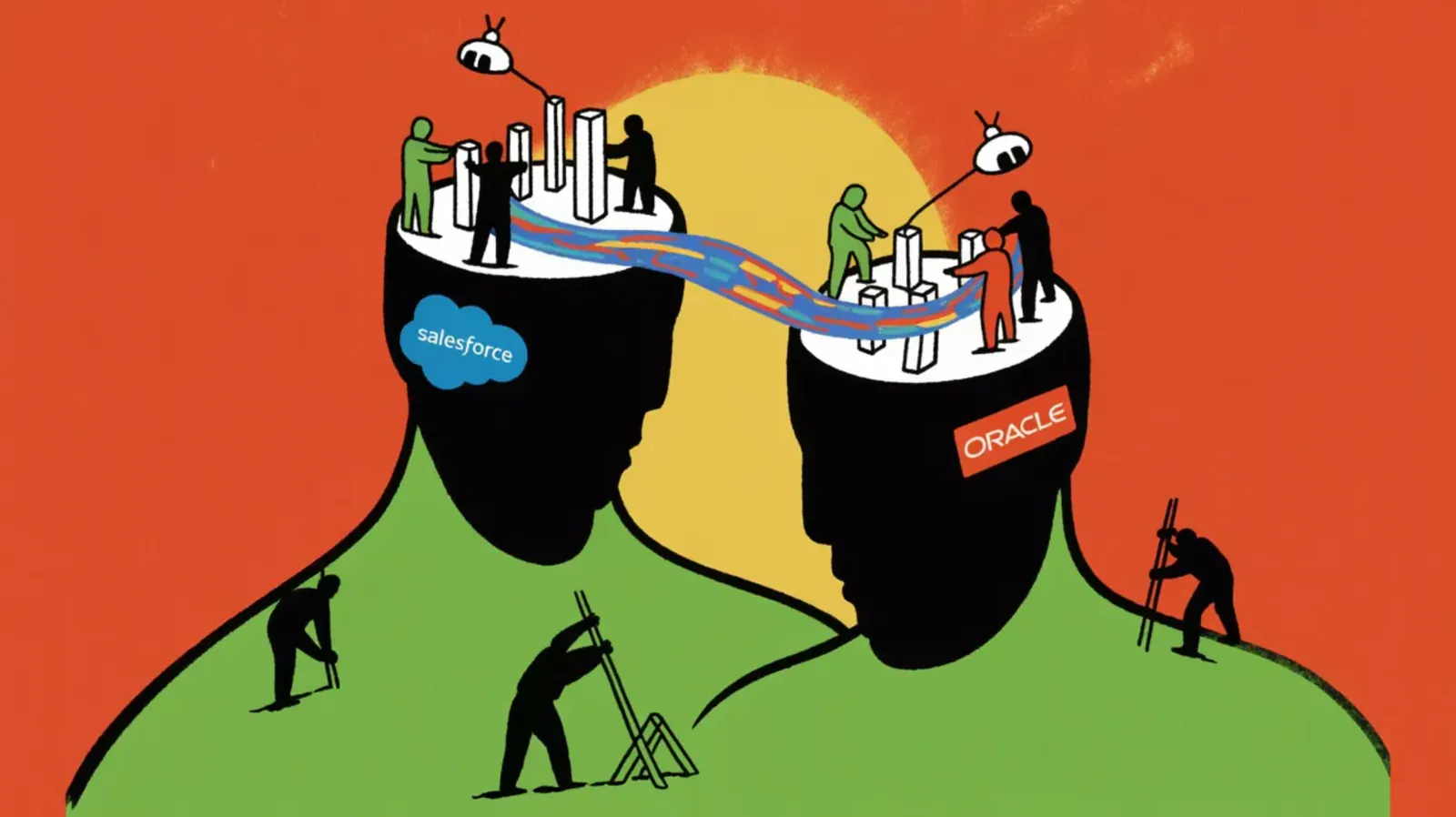
That's why enterprise platforms like Salesforce and Oracle have become central. They centralize information, keep it consistent, and expose it in a way that AI can use without stumbling.
Any serious enterprise AI project needs to rest on a reliable data platform. Without that foundation, everything else collapses like a house of cards.
The human factor, the great misunderstanding
One of the biggest confusions is thinking that AI is here to replace the team. The reality is a lot more interesting: it's here to boost it.
From repetitive tasks to strategic tasks
When AI absorbs the routine work, the human team is free to do what only a human can do. Think, create, negotiate, empathize, question.
Productivity goes up, and so does the quality of the work. Professionals start spending their time on things that matter to them, not on moving paperwork from one place to another.
New skills, new roles
Of course, this requires learning. Knowing how to converse with a model, evaluate its answers, and combine them with human judgment is becoming a cross-functional skill.
Companies that understand this invest as much in training as in technology. The pairing of people and AI is what really moves the needle.
How to take the first step without breaking anything
Getting started with AI doesn't mean transforming the entire company overnight. The healthiest approach is to choose a concrete, measurable use case with visible impact.
Identify a real pain point
The first exercise is to ask yourself which problem is consuming time, money, or patience. AI is most useful when it tackles something specific rather than when it's applied vaguely.
Is the sales team losing leads because it can't respond in time? Does the finance department spend hours sorting invoices? Is marketing unable to segment well? Each of those pain points has a concrete, measurable solution.
Test, measure, scale
Once you've identified the use case, it's best to start with a limited pilot. Test for three months, measure the results, adjust, and scale what works.
The most common trap is trying to do everything at once. Big implementations that promise to revolutionize everything tend to end in frustration and a burned budget.
Work with experts
Few companies have all the capabilities in-house to implement enterprise AI end to end. Finding a partner with experience, success stories, and deep knowledge of the business speeds up the process several times over.
If you want to see how your company would apply these technologies, the fastest way is to book a demo. It's the most direct way to go from curiosity to a concrete plan, with real numbers and timelines.
Myths worth clearing up once and for all
Around enterprise AI there are myths that delay decisions and burn valuable time. They're worth putting on the table.
"AI is only for giant companies"
False. Mid-sized companies are the ones capturing value from AI fastest today, because they have more agile structures and less rigid processes.
What has changed recently is the cost of entry. What used to be out of reach is now bought as a monthly service.
"We have to wait for it to mature"
Another classic. The technology will keep maturing, but competitive advantages are built in the meantime.
Whoever starts now learns now. Whoever learns now optimizes first. Whoever optimizes first almost always wins first.
"It's going to replace my team"
This is the most expensive misunderstanding. AI replaces tasks, not people, and frees up time so people can do what really makes them valuable.
Teams that adopt a well-implemented AI end up more motivated, not less. They stop doing the boring work and go back to what they are passionate about.
What's coming is faster, cheaper and more useful
Enterprise AI is evolving at a pace that surprises even those of us who work in the field. Every quarter brings more powerful, more efficient and more specialized models.
The opportunity is not in waiting for the perfect version, but in starting with what is already available. The tools exist, the data does too, and the use cases of AI in companies are more than proven.
The only thing missing is the decision. And that one is still one hundred percent human.