
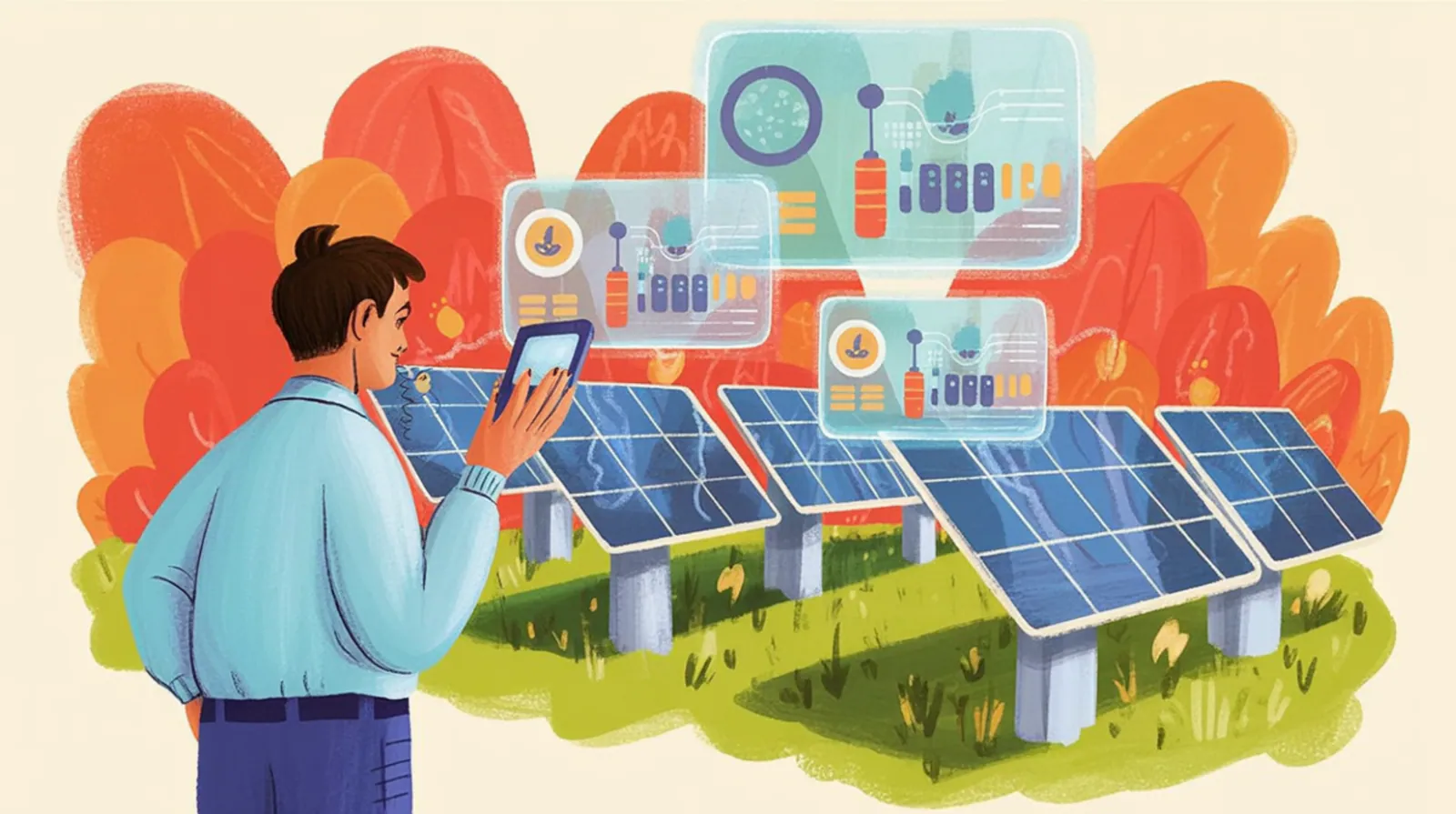
The energy sector is, literally, what keeps the world moving. Every time you turn on a light, charge your phone or start up a factory, there is a gigantic network of decisions working behind the scenes.
The problem is that this network has become too complex to manage by hand. Demand goes up and down without warning, infrastructure ages and renewable energy adds new variables every day.
This is where artificial intelligence in the energy sector comes in, a technology that stopped being science fiction and became a concrete tool. And the companies that adopt it are building an advantage that is hard to catch up with.
The most interesting part is that we are not talking about a distant future. These systems are already running, saving money and preventing headaches in real operations across Latin America.
What is artificial intelligence applied to energy?
When we talk about AI in energy, we mean the use of machine learning and deep learning models to understand and improve how energy is generated, distributed and consumed.
In plain terms: they are systems that learn from data and detect patterns that a person could never process at that speed.
Think about the amount of information a single power plant produces every minute. Sensors, measurements, consumption readings, alerts: a volume impossible to analyze manually.
AI takes all that chaos of data and turns it into accurate predictions and actionable recommendations. That is the real magic, and there is nothing magical about it: it is math at scale.
The difference from traditional software is huge. A standard program follows fixed rules, while AI improves with every new piece of data it receives.
Why energy needs AI right now
Organizations in the industry face challenges that sound like something out of a disaster movie. And that is no exaggeration.
First, there is demand volatility: predicting how much energy a city will need tomorrow is fiendishly hard. One extremely hot day can spike air conditioning consumption and shake the whole system.
Second, the pressure to reduce carbon emissions. There is a global urgency to decarbonize, and that forces you to rethink every process from scratch.
Third, the uncomfortable reality of aging infrastructure. Many power grids were designed decades ago, for a world that no longer exists.
And fourth, the need to improve operational efficiency without spending a fortune. Here AI is not a luxury: it is the difference between growing and being left out of the game.
Industries like oil and gas feel this pressure every day, where every hour of equipment downtime costs frightening amounts.
On top of that comes a key detail: the shortage of specialized staff. Finding people who know how to operate critical infrastructure is getting harder, and AI helps multiply the capacity of the teams you already have.
The concrete benefits of AI in the energy sector
This is where things get interesting. Because theory is one thing, and results measured in money are something very different.
The great advantage of AI is its ability to analyze huge volumes of data with a consistency that no human team can match. This translates into more accurate predictions and smarter decisions.
The best part is that these benefits span the entire chain: from generation and distribution to asset maintenance and the end customer experience.
Demand forecasting with unprecedented accuracy
Imagine knowing, hours or days ahead, exactly how much energy your grid will consume. That is no longer a dream.
AI models combine historical data, weather forecasts and consumption patterns to anticipate peaks and valleys with surprising accuracy.
The result is less waste, less overload and a much more stable operation. Forecasting stops being guesswork and becomes a reliable science.
This hits the bottom line directly, because every unit of energy miscalculated is money that evaporates or a blackout risk.
Predictive maintenance that saves millions
This is one of the most powerful use cases of all. Instead of waiting for something to break, AI predicts when a piece of equipment is going to fail before it happens.
In a pilot published by McKinsey, smart scheduling of crews at a U.S. electric and gas utility raised field productivity by 20% to 30% and cut wasted trips by 80% (McKinsey, 2023).
In another case, Vistra's Martin Lake plant in Texas followed the recommendations of an AI model to convert fuel into electricity more effectively, and within three months it was running more than 2% more efficiently, saving 4.5 million dollars per year (McKinsey, 2022). It sounds small, but at that scale, it is a gigantic figure.
The logic is simple and powerful: fixing something before it fails is always cheaper than reacting to an emergency.
Power grids that think for themselves
Smart grids go far beyond traditional control and monitoring systems. They give companies the ability to manage distribution remotely and automatically.
This means greater resilience to outages, faster maintenance and distribution that adjusts itself to the need of each moment.
A self-regulating grid can reroute energy when it detects a problem, preventing an isolated failure from turning into a massive blackout.
Artificial intelligence use cases in energy that are already working
Enough theory. Let's see how all of this applies in the real world, because AI use cases in the energy sector multiply every day.
The good news is that none of these examples is experimental. They are proven applications that already generate value in real operations.
Asset inspection with drones and computer vision
Drones equipped with computer vision can inspect towers, pipelines and equipment while they keep operating. No need to shut everything down to check.
This greatly improves worker safety in dangerous conditions and makes it possible to detect problems before they escalate.
Managing industrial machinery and field assets becomes much safer and more efficient with this kind of technology.
Faster decisions based on data
Analytical AI brings order to the chaos of information to optimize materials logistics, maintenance schedules and field task planning.
This is where conversational business intelligence platforms like Metrix make a huge difference. Instead of waiting days for reports, you ask your data questions in natural language and get the answer instantly.
That response speed is exactly what Field Service teams need to make the right decisions on the move.
When anyone on the team can query data without knowing how to code, information is democratized and the whole operation speeds up.
Renewable energy integration
Adding renewable sources to the grid is a real technical puzzle. The sun and the wind are not constant, and that complicates every calculation.
AI helps forecast renewable production and balance the different sources according to actual demand. That way, companies move toward their sustainability goals without sacrificing stability.
This balancing capability is key to a future where clean and reliable have to coexist without friction.
Cybersecurity for critical infrastructure
As power grids become more digital, they also become targets for cyberattacks. And an attack on a country's grid is a very serious problem.
AI can automate threat detection and response in real time, much faster than any human team. It also strengthens authentication methods for the huge number of connected devices.
That's why having a secure platform stops being an optional detail and becomes a basic, non-negotiable requirement.
Generative AI: the leap almost nobody saw coming
If traditional machine learning was already impressive, generative artificial intelligence opened a completely new dimension.
This technology, powered by large language models, is not limited to analyzing data: it creates, converses and reasons in a way that feels almost human.
Customer experiences that feel human
Generative AI chatbots can serve customers with much more empathetic and intelligent responses. The robotic, frustrating answers of the past are gone.
An energy company can use conversational agents on WhatsApp, like the ones Sellium powers, to resolve inquiries and handle complaints without endless delays.
The same applies to marketing: tools like Revio let you build personalized relationships with each customer at massive scale.
Technical manuals that come to life
Here is something truly fascinating. Generative systems can be trained on highly specialized technical manuals to assist technicians directly in the field.
Imagine a technician who, instead of flipping through a manual hundreds of pages long, asks an AI assistant and gets the exact answer in seconds.
Document processing solutions like Arconte turn those dense, dull files into instantly accessible knowledge.
Deeper insights from unstructured data
Generative AI can ingest and analyze data from a wide variety of sources: audio, video, images, weather forecasts and much more.
This boosts predictive maintenance of assets such as transmission lines, opening a layer of analysis that was impossible until recently.
Where there used to be scattered data with no value, there are now patterns that anticipate failures and improvement opportunities.
The future of AI in the energy sector
What's coming is even more ambitious. AI will not only improve current systems: it will transform how we produce and consume energy from the root.
We are heading toward plants and grids with greater automation, where AI assists in critical decisions on distribution, fault correction and maintenance with minimal human intervention.
AI-powered robotics will become more and more sophisticated, capable of performing inspections and repairs in dangerous environments. That means less risk for people and more operational continuity.
Even in complex processes such as carbon capture and storage, AI promises to optimize chemical reactions and monitor system performance.
Heavy logistics also benefits: fleet coordination with platforms like Trazzo optimizes every delivery in the field down to the last mile.
The picture is clear: AI is going to reach every corner of the sector, driving efficiency, sustainability and resilience at the same time.
How to take the first step without getting overwhelmed
All this technology can sound overwhelming, but the key is not to try to cover everything at once. Smart adoption starts with a specific, measurable use case.
The secret is choosing the right technology partner. Working on robust ecosystems like Salesforce and Oracle gives you a solid base on which to build AI agents that really move the needle.
The difference between the companies that lead and the ones that fall behind is not budget: it's daring to start. Those who start early build up advantages that are extremely expensive to catch up with later.
If you want to see how this applies to your operation, you can book a demo and explore the possibilities with no commitment.
Frequently asked questions about AI in the energy sector
Does artificial intelligence replace workers in the energy sector?
No, the idea is not to replace people but to empower them. AI takes on the repetitive and dangerous tasks, while human teams focus on strategic decisions and higher-value work.
Do I need to be a huge company to implement AI in energy?
Not at all. Today there are modular solutions that fit mid-sized organizations, letting you start with a small, focused project and scale at your own pace.
How long does it take to see a return on investment?
It depends on the use case, but many companies see efficiency improvements in the first few months. Predictive maintenance and demand optimization tend to deliver fast, tangible results.
Is it safe to connect AI to critical infrastructure?
Yes, as long as you work with platforms that prioritize security by design. A well-protected architecture and constant monitoring are the foundation of any serious implementation.