No. To launch an AI agent you don't need a flawless CRM: incomplete contact data gets filled in by conversation. What does have to be right from day one is the business data the agent uses to answer (prices, stock, balances and stages), because there a bad data point is a wrong answer to the customer.
The scene repeats itself before many projects. The head of sales wants an agent that handles WhatsApp, and someone from IT or administration stops it with a reasonable line: "first we have to clean up the CRM." Six months later, the CRM is unchanged and the agent doesn't exist. As happens in many Salesforce or Oracle projects, what holds things up is not the platform but how the work is approached.
This guide separates what has to be right from what can wait, explains what gets recorded after each conversation, and proposes a minimal task list, each task with an owner.
Do you have to clean up the CRM before launching an AI agent?
The concern is justified. According to Gartner (2025), 63% of organizations don't have the data management practices AI needs, or don't know whether they have them. And the problem isn't only about tidiness: in the connectivity report from MuleSoft (2025), 95% of 1,050 IT leaders say they struggle to integrate data across systems, and on average only 29% of a company's applications are integrated.
It doesn't follow that you have to clean everything before starting. A general cleanup project has three problems. It's long, because if everything is a priority nobody knows where to start. It's expensive, because it competes with the daily work of the same people who know the data. And it ages: people change companies, roles or phone numbers, and what you fix today is stale again before anyone uses it.
The useful question is a different one: which data will the agent use to answer, and how strict does it need to be? Two very different groups show up.
Two types of data, two levels of strictness
A WhatsApp sales agent touches two kinds of information in every conversation:
Contact data: who the person is, which company they're with, their role, what they're looking for and how they prefer to be messaged. If any of it is missing, the agent asks.
Business data: the price that applies to that customer, available stock, their balance and credit, their payment and delivery terms, the stage of their opportunity. If any of it is wrong, the agent repeats it as is.
The difference is in the consequences. A contact without a role or a company is an incomplete record: it's a nuisance in a report, but nobody promised anything to anyone. An outdated price or a stock level that doesn't exist is a commitment to the customer that the company then has to honor or explain.
That's why the standard can't be the same. You can start with the first group as it is. The second group gets reviewed before the agent says its first word.
Contact data: the agent fills it in by conversation
When someone writes on WhatsApp, the channel has already solved the hardest piece of data to get: a valid number, from a person who wants to talk to your company. The rest comes from the conversation. The agent asks what it needs to help (name, company, product, quantity, by when and who decides) and records it, instead of someone entering it by hand at the end of the day.
In Latin America, the typical contact problems aren't solved with a mass cleanup but with a clear rule for each case:
Numbers without a country code: the same mobile number appears with and without +52, +57 or +54, with spaces or with hyphens, and in Argentina sometimes with the local 15 instead of the 9 of the international format. Normalizing the format when you identify the sender keeps one person from showing up as two.
Duplicates by phone number: a buyer's number is listed as a lead and as a contact, or a company's reception phone is entered in five different contacts. It's worth deciding in advance which record takes precedence when the number matches.
Personal or corporate number: the buyer who changes companies and keeps their WhatsApp, or the sales rep who used to answer from a personal phone. The number identifies a person, not always an account, so the conversation has to confirm which company they're buying for.
Consent: someone messaging you allows you to reply. Messaging them first, months later, requires that they have agreed to receive messages from your company and an approved Meta template. No conversation fills in this data point: it has to be recorded, with a date and a source.
The last point marks the limit of the idea. Filling in data by conversation works with whoever writes to you. To reach out to old contacts in your database, opt-in is a prerequisite, and the rules from Meta and the region's data laws are covered in WhatsApp marketing and compliance.
Business data: it has to be right from day one
A language model doesn't query a database before it speaks: if nobody gives it the data, it fills in with something that sounds reasonable. That's why a reliable sales agent doesn't pull prices or stock from the model's memory, but from a live query to your systems. We cover it in how to keep an AI agent from making up prices or stock.
That rule prevents invention, but it doesn't fix bad data at the source. If the price list in your system is wrong, the agent repeats it with complete confidence, just like a sales rep who trusts the system would. These are the data points to check before launch:
Prices: the list that applies to each customer or channel, with its volume tiers and current promotions. A general price list in a PDF from two months ago won't do.
Stock: by warehouse or branch, specifically the one that supplies the customer's area. If the system says it's in stock and the warehouse doesn't have it, the shortage shows up when the truck arrives.
Balances and credit: each customer's account statement, so you don't confirm the order of an account with an overdue balance.
Terms: payment term, delivery days, zone and minimum order for each account.
Stages: if each sales rep uses the opportunity stages their own way, any rule that depends on them fails, whether a person or an agent follows it.
It helps to be clear about which system rules in each case: the ERP is the source of truth for stock, prices and balances, and the CRM for the commercial relationship. With a single source of truth for each data point, the agent knows where to look and nobody argues about which of two spreadsheets is the right one. The ways to connect the ERP are in selling on WhatsApp with your ERP, and how the price is built from your lists is in automatic quotes on WhatsApp.
If a data point is missing, the agent doesn't guess: it asks again, says it will confirm, or hands the conversation to a person. In the first weeks, those gaps show up as extra handoffs, and each one tells you which information to complete first.
What gets recorded in Salesforce after each conversation?
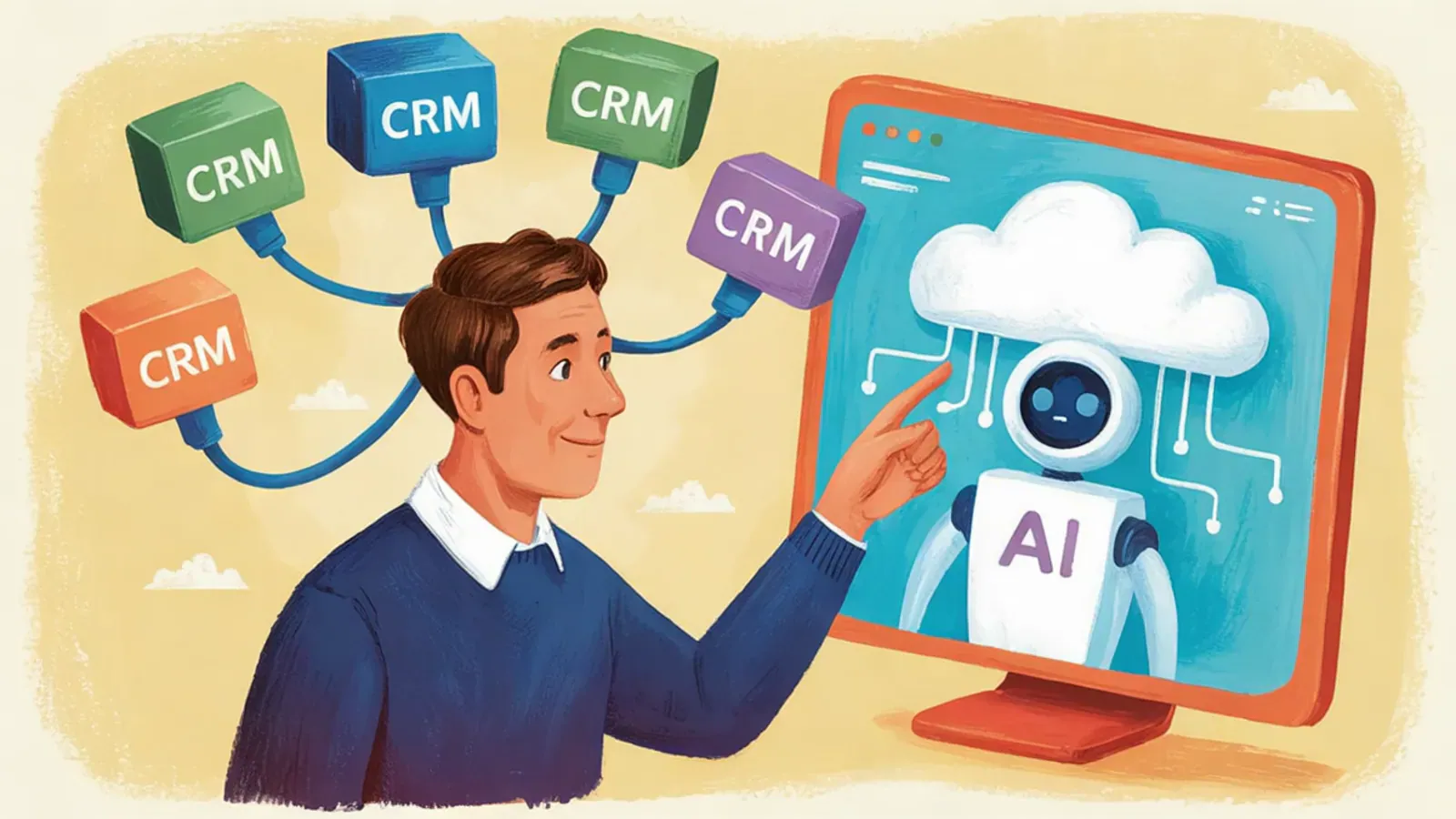
This is why the CRM improves once the agent is running, not before. In an integration that operates inside the org, like Sellium with Salesforce, each conversation creates or updates the lead or contact with what was discussed:
Source: the ad, QR code or website button that started the conversation, linked to your campaign.
Qualification: budget, authority, need and timeline, as fields on the record.
Summary: what the customer asked for and what was offered, in the record's activity.
Owner and next step: the assignment according to your rules and the task or meeting already created.
You define the objects it touches, typically leads, contacts, opportunities and activities, and the agent operates with an integration user that has the permissions you configure: every change is kept in Salesforce's standard history. On the ERP side, the main write is the sales order for the confirmed order.
Note: this is not a CRM cleanup. The agent improves the records it touches, those of the people who talk to it. Contacts of customers who haven't written in years stay as they were. For most companies that's enough: the data in use stays current, and the data nobody uses doesn't eat up anyone's hours.
Minimum checklist, with one owner per task
Before you let the agent respond, this list is enough. Each task has a name next to it, because a task that belongs to "the team" ends up being nobody's task.
Prices: a current list per customer or channel, inside the system, with no parallel PDFs. Owner: sales administration.
Stock: by warehouse, updated as often as you sell. Owner: logistics or warehouse.
Balances and credit: up-to-date account statements and a written rule for what happens with an overdue account. Owner: credit and collections.
Catalog: codes, units and equivalences with the names customers use, whether it's the brand, the size or the product's nickname. Owner: product or purchasing.
Stages and owners: what each stage means and who owns each account, so the agent knows whom to hand off to. Owner: sales management.
Consent: where the opt-in is recorded and how opt-outs are honored. Owner: marketing.
Permissions: an integration user with the minimum needed to read and write what applies. Owner: IT.
What can wait without guilt: the old activity history, fields nobody has filled in for years, duplicates of inactive customers and contacts without a phone number. If a campaign to that database is ever needed, you clean up the segment you're going to use, not the whole database. It's the logic of any data quality work: use first, cleanup after. To review the rest of what's worth having resolved before choosing a vendor, there's the checklist for choosing an AI sales agent.
Suggestion mode before autonomous mode
The last piece is trust, and it's built in stages. A common practice is to start with the agent in suggestion mode: it proposes the reply or the action and a person approves it before it goes out. This is what's known as human-in-the-loop, and it lets you see with real conversations where the agent gets it right and where it lacks information.
Another way to go step by step is to narrow the scope: first a group of customers, a time window or a type of inquiry, with conversation review, and then the whole channel. In both cases, those weeks answer the opening question better than any prior audit, because they show which data is really missing: the data the agent looked for and didn't find.
Three signals tell you it's time to expand:
Price and stock answers match the ERP in a reviewed sample.
Handoffs caused by missing data go down week over week.
Your sales team stops correcting what the agent logged.
The step-by-step of an implementation, from the data to going live in production, is in how to implement an AI agent in 4 to 6 weeks, and what happens when the agent hands the conversation to a person is in handoff to a sales rep.
Waiting for a perfect CRM means waiting for something that never arrives. Cleaning up prices, stock and balances does have a finish date, and it is what your customer will notice. If you want to review which data in your operation is ready and which is not, book a demo and we will go through it on your own systems.