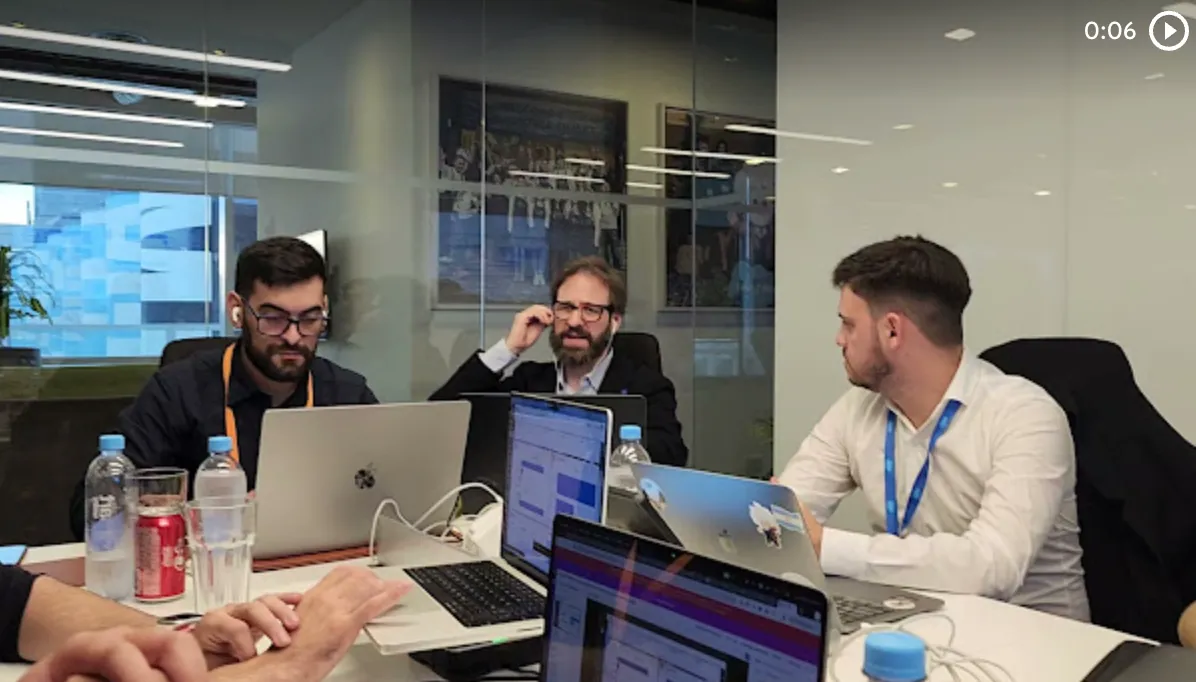
How an AI sales agent gets implemented: the 4- to 6-week plan
The most common objection to an AI agent is not the price: it is the fear of a months-long project that ties up the sales and IT teams. With a managed service, implementation takes 4 to 6 weeks and your team contributes knowledge and approvals, not hours of coding. Here is the plan week by week, what each side provides and what slows it down.
How long does it take to implement an AI sales agent, and what do you need?
Implementing an AI sales agent with Sellium takes 4 to 6 weeks, in three stages: discovery in weeks 1 and 2 (sales process, catalog, pricing rules and channels), configuration and integration with your CRM, ERP and payment providers in weeks 3 and 4, and validation with real cases plus a gradual launch in weeks 5 and 6.
On your side, you need four things: someone who knows the sales rules, access to the data and systems, your WhatsApp number on the official API, and time to validate. Our team handles the configuration, catalog setup, integrations and agent training: no coding required and no in-house technical team needed. For agents in other departments, see how an AI agent is implemented.
The implementation plan, week by week
Every stage ends with something concrete that your team reviews and approves before moving to the next one. That way the project never moves forward blindly, and nobody finds out at the end that the agent answers differently from what the sales team expected.
| Stage | What Vantegrate does | What your team provides | What you have at the end |
|---|---|---|---|
| Weeks 1 and 2: discovery | Maps the sales process, catalog, pricing rules and channels, and reviews the systems and data the agent will query | One or two people who know how you sell, your price lists, examples of real conversations and access to the systems | The agent's scope and prioritized use cases, approved by your team |
| Weeks 3 and 4: build | Configures the agent, connects it to the CRM, ERP and payment providers, loads the catalog and trains it on your real data | Answers to the questions that come up (a discount rule, a special product) and the integration user with the agreed permissions | The agent running in a test environment, with your data |
| Weeks 5 and 6: validation and launch | Tests with real cases, fine-tunes and turns the agent on in production gradually, alongside your team at every step | People who test as if they were customers, the final sign-off and whoever takes the handoffs | The agent selling on WhatsApp to your real customers |
| After launch | Maintains the agent: adjusts answers and rules, keeps up with catalog or price changes and adds use cases | Letting us know about commercial changes the agent needs to know | An agent that stays current with your operation |
The timeline depends mostly on how many systems need to be connected and how clean the catalog and price lists are. If the case is more complex, the timeline is agreed at the end of discovery, before the build.
What your team provides during implementation
Implementation is turnkey, but it is not blind: the agent will sell by your rules, and your people know those rules. What we ask of your team is knowledge and decisions, not development hours. Here is the full list.
- Sales lead: someone who knows how you sell, what can be promised and what cannot, and who can make the call when a question comes up. This is the most important person on the project.
- Commercial data: the catalog with its codes and units, price lists by customer or channel, promotions, and delivery and payment terms.
- Systems: an integration user for the CRM and ERP, with permissions limited to what the agent needs to read and write. How each system connects is covered in selling on WhatsApp with your ERP.
- WhatsApp number: your company number on the official WhatsApp Business API, with the Meta account in your name. If you sell from the app, the path is in migrating WhatsApp Business to the API.
- Real conversations: examples of how customers write to you, voice notes and messy orders included, to train and test the agent on real cases.
- Handoffs: the people who take what the agent cannot resolve on its own, during which hours and with what information. The step-by-step process is in AI agent to human handoff.
What you do not need: coding, designing conversation flows or hiring a technical profile. Sellium is a managed solution: our team handles the configuration, catalog setup, integrations and training.
What shortens and what stretches an AI agent implementation
The four- to six-week timeline assumes a project where the data exists and someone makes decisions. What stretches it is almost never the AI: it is a piece of data nobody can find, access that takes too long or a rule nobody wants to define.
This is not just a small-company problem. In Gartner's survey of data management leaders, 63% of organizations either do not have, or are unsure whether they have, the data management practices AI requires (Gartner, 2025). That is why discovery starts with the data, not the agent.
| Factor | Shortens the timeline | Stretches it |
|---|---|---|
| Catalog | Unique codes, clear units and the names customers actually use | Duplicate codes, descriptions nobody uses and equivalents only one rep knows |
| Price lists and rules | Price lists in the ERP and written sales rules | Prices in loose spreadsheets and exceptions decided case by case |
| Systems | ERP and CRM with an API and an integration user available | Systems without an API, several ERPs or permissions that need many approvals |
| WhatsApp number | Number already on the official API, with the business verified by Meta | Number still on the app, or business verification pending |
| Scope | One or two use cases to start, such as inquiries and orders | Wanting everything on day one: sales, payments, after-sales and complaints |
| Decisions | A sales lead who approves the same day | Approvals waiting for the next committee meeting |
Whatever could stretch the timeline is caught in discovery, with time to fix it before the build.
How the gradual launch works
The agent is not switched on for every customer on the same day. The launch is gradual: it starts with part of the traffic, the real conversations get reviewed, and it expands when the numbers hold up. That way a configuration mistake reaches few customers and gets fixed fast.
How to stage it is decided in discovery, based on each company's risk and volume. These are the three most common approaches, and they can be combined.
- By hours: the agent first covers after-hours, when nobody answers, and then takes on the rest of the day.
- By use case: it starts with price and inventory inquiries, then adds orders, quotes or payments.
- By customer group: it starts with one region, channel or set of accounts, then extends to the rest.
Before expanding: a sample of conversations gets reviewed, handoffs and errors are checked, and everything is compared against the baseline. What to measure and how to read it is in AI sales agent KPIs.
Six mistakes that delay implementation
AI projects that stall rarely stall because of the model. In McKinsey's global survey, out of the 25 attributes it tested, redesigning workflows has the biggest effect on the bottom-line impact of generative AI (McKinsey, 2025). These are the most common mistakes.
- Starting with the tool: picking a platform before knowing what the agent needs to solve. To pin down requirements before talking to vendors, use the AI sales agent checklist.
- A sales lead with no time: if the person who knows the sales rules cannot answer the same day, every question costs a week.
- Data in spreadsheets: price lists and inventory living outside the ERP. The agent sells with what it queries, and a copy goes stale.
- Everything on day one: adding sales, payments, after-sales and complaints in the first stage. Start with one or two use cases, measure and expand.
- Testing only the easy stuff: validating with textbook questions. Testing has to include voice notes, messy orders, customers in a hurry and orders outside the rules.
- Handoffs with no owner: turning on the agent without defining who takes what it cannot resolve. The customer is left waiting and the sale is lost.
In-house build, platform or managed service: what changes in implementation
Four to six weeks is the timeline for a managed service. With another path, the calendar changes and, above all, so does who does the work, and it is worth knowing before you compare proposals.
MIT NANDA's report on generative AI in companies found that external partnerships with learning-capable, customized tools reach deployment ~67% of the time, against ~33% for internal builds (self-reported data, MIT NANDA, 2025). To compare a platform with a managed service using your own numbers, try the self-service vs managed comparison.
| Path | Who does the work | What the timeline depends on |
|---|---|---|
| In-house build | Your IT team: the model, the integration with WhatsApp, the ERP and the CRM, testing and maintenance | The team's availability and how much it has to learn along the way |
| Self-service platform | Your team builds the flows, loads the catalog, integrates and trains the agent with the platform's tools | The internal hours you can put in and the connectors the platform offers |
| Managed service | The vendor runs discovery, configures, integrates and trains; your team brings the rules and validates | Discovery: how many systems need connecting and how clean the data is |
In all three cases, someone at your company has to define the sales rules: that part cannot be outsourced.
The six deliverables of a Sellium implementation
Each step ends with something your team sees, tests or approves before moving on.
Kickoff and discovery
Kickoff meeting with the sales and IT teams. We review how you sell, which channels inquiries come through and which system holds each piece of data.
Approved scope
By the end of week 2, the scope is set: what the agent does, which use cases it starts with, what it hands off and to whom. Your team approves it before the build.
Agent connected
Agent configuration and integration with the CRM, ERP and payment providers, through an integration user with limited permissions.
Trained on your data
Catalog, price lists, sales rules and examples of real conversations. The agent answers only with what is in your systems.
Testing with real cases
Your team tests as if they were customers: voice notes, messy orders and exceptions. We fine-tune until the answers match a good sales rep's.
Gradual launch
Staged activation in production, with conversation and metric reviews, and our team alongside you at every step.
What the data says about implementing AI
Third-party figures with published sources on why AI projects move forward or stall. None of them is a Sellium result.
~67%
Of the time, external partnerships with learning-capable, customized tools reach deployment; internal builds, ~33%
21%
Of companies using generative AI have fundamentally redesigned at least some of their workflows
63%
Of organizations either lack, or are unsure whether they have, the data management practices AI requires
95%
Of IT leaders struggle to integrate data across systems, the foundation AI needs
Caveats: the MIT NANDA report is based on interviews at 52 organizations, a survey of 153 leaders and a review of more than 300 public initiatives, it measures generative AI projects in general, not sales agents, and its outcomes are self-reported. The McKinsey survey covers companies across all industries; in the same study, workflow redesign is the attribute with the biggest effect on bottom-line impact. The Gartner survey covered 1,203 data management leaders, and the MuleSoft report is based on interviews with 1,050 IT leaders.
Sellium: the agent that is delivered up and running
Sellium is a managed solution: our team handles discovery, the integration with your systems, catalog setup and training, and afterward we keep it up to date with your operation. Your team brings the sales rules and approves each stage.

Sellium
AI sales agent for WhatsApp
Sellium is Vantegrate's AI sales agent for WhatsApp: it runs on the official API, answers with your real catalog, prices and inventory, quotes, takes orders, collects payment in the chat and logs everything in your CRM, 24/7.
Explore SelliumSecure AI agents
Sellium runs 100% on Salesforce and Oracle Cloud infrastructure, certified SOC 2 Type II and ISO 27001. Vantegrate enables, the customer operates and certifies.
See the security modelISV and Consulting PartnerRuns inside your Salesforce
Sellium reads and writes your objects, respects your profiles and permissions, and works alongside Agentforce and your existing flows.
Vantegrate and SalesforceFrequently asked questions about implementing an AI sales agent
What sales leadership and IT ask before kicking off the project.
How long does it take to implement an AI sales agent?
How long does it take to implement an AI sales agent?
With Sellium, 4 to 6 weeks. The first two are discovery (process, catalog and rules), the next two are configuration and integration with your systems, and the last ones are validation with real cases and a gradual launch. If several systems need connecting or the ERP has no API, the timeline is agreed at the end of discovery.
Do I need a technical team to implement an AI agent?
Do I need a technical team to implement an AI agent?
No. Sellium is a managed solution: our team handles the configuration, catalog setup, integrations and training. On your side, you need someone who knows the sales rules, access to the systems and people who validate and approve each stage. There is no coding involved.
Can I start with a single use case?
Can I start with a single use case?
Yes, and that is what we recommend. Starting with one or two cases, such as price and inventory inquiries or order taking, lets you measure and adjust quickly; then you add quotes, payments or quote follow-up without redoing what already works.
What happens after launch?
What happens after launch?
The agent is not left on its own: we keep it up to date with your catalog, price and rule changes, fine-tune answers based on real conversations and add use cases when you need them. To track results, agree on the KPIs and the baseline before you start, as we explain in AI sales agent KPIs.
What happens to my customers' data during implementation?
What happens to my customers' data during implementation?
It is handled the same way as in production. Sellium runs on the official API for WhatsApp Business, connects to your systems through an integration user with the permissions you grant, and we sign data processing agreements. The details are on our security page.
How much does it cost to implement an AI agent with Sellium?
How much does it cost to implement an AI agent with Sellium?
Sellium is priced in two parts: an initial implementation quoted for each company, which includes discovery, integration, training and fine-tuning, and a monthly subscription with AI credits that scale up, with no lock-in. You pay for WhatsApp messages directly to Meta, on your own account and with no markup from us. To get a price for your case, request a quote.
Let's map out your implementation plan
Tell us what you sell, where your inquiries come from and which systems you use. We'll show you what your 4 to 6 weeks with Sellium would look like and what we'd need from your team at each stage.
 Francisco Morales, co-founder, takes your call. We reply on WhatsApp within 4 business hours, no strings attached.