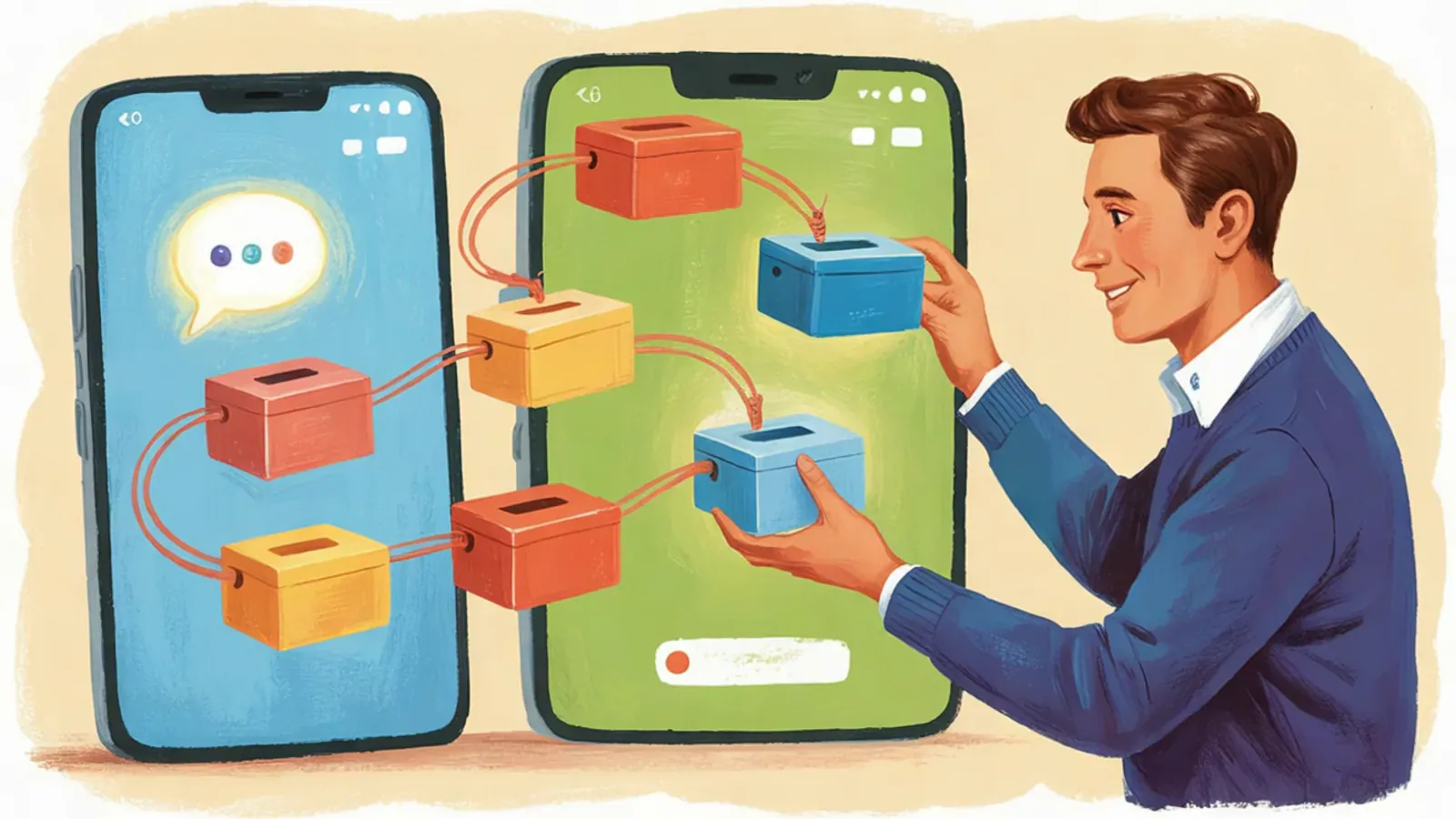

To avoid losing the visit requests that come in after hours, you need to respond to them right away: identify the customer, triage the failure, offer a real time window and leave the work order created. Whatever can't be closed that night gets picked up first thing in the morning, before the customer writes to another company.
In the United States, the classic problem for a service company is the call that goes to voicemail. In Latin America it takes another form: the WhatsApp message that arrives at nine at night to a company with technicians out in the field (HVAC, elevators, industrial equipment, home appliances, building maintenance) and that nobody reads until the next day.
This guide follows that request from start to finish: what to ask before scheduling, how to offer a visit that actually happens, how to keep the technician from showing up at an empty house, what to do with conversations left half finished and why a repair is the best moment to sell preventive maintenance.
The request that arrives at 21 and nobody answers
An example. It's July in Monterrey and the air conditioning in an office stops cooling at 20:40. The facilities manager writes on WhatsApp to the company that did the installation. There's no response. They look up two other providers, write to them too, and the first one that replies with a visit time gets the job. Often, it also gets the maintenance contract that follows.
It isn't neglect. The service desk works business hours, the WhatsApp number is usually on a coordinator's phone and, the next day, that message is one of forty. After hours also means Saturdays, holidays and heat wave days, when you can't keep up even during business hours.
What gets lost isn't just a visit. It's the customer who already trusted you and who now has another technician's number saved. It's the same phenomenon we described for sales that come in after hours, with an aggravating factor: someone with broken equipment can't wait for you to open.
What does triage need to ask before scheduling?
Triage means classifying the request before sending anyone. Good triage answers three questions: whether a visit is needed, who has to go and with what. For that it needs this information:
- Issue: what is wrong with the equipment, since when and whether the display shows an error code.
- Equipment: brand, model and, if possible, the serial number.
- Area: the address, to know which technicians can get there.
- Urgency: whether the equipment is down or working partially, and whether there is any risk.
- Access: during which hours someone is on site, whether there is a front desk or whether authorization from the building manager is needed.
- Coverage: whether the customer has a current contract or warranty.
On WhatsApp, a good part of this arrives in a forty-second voice note, with the noise of the equipment in the background. An agent like Sellium transcribes and interprets those voice notes, so the customer doesn't have to type what they would rather say out loud. Many companies also ask for a photo of the equipment's nameplate or display, which the technician reviews before heading out.
In its Field Service version, Sellium identifies the customer against your service system by contract number, tax ID, address or serial number, checks whether they have coverage and runs a questionnaire by equipment type and failure, with error codes and guided resets. Some failures get solved without a visit; the ones that don't go out with the prior diagnosis already entered. That helps with first-visit resolution: according to Aberdeen Group, via PTC (2024), the industry average resolves 80% of orders on the first visit and the best performers reach 88%.
There is a limit you define before starting: emergencies are not automated. A smell of gas, a water leak or a critical piece of equipment out of service must go immediately to the on-call person, with the full conversation. It is a human handoff that allows no delay.
Scheduling by area and specialty, with the work order already created
Replying "we'll call you tomorrow to coordinate" at ten at night is almost the same as not replying. What retains the customer is a specific window, and a specific window can only be offered if you know which technician can go: the one certified for that equipment, who works in that area and has room in the schedule.
That is the task Sellium performs on top of your service system (Salesforce Field Service, Oracle Field Service, ServiceMax or Dynamics 365 Field Service, among others): it offers real windows by checking each technician's specialty, area and workload, and leaves the work order reserved with the diagnosis. Saturday at ten at night, it also schedules for Monday at eight. It doesn't replace your system: it reserves the order in the one you already use.
Some visit scheduling rules that help the appointment get kept:
- Offer few options, two or three, with short time slots instead of "in the morning".
- Confirm the full address and who will receive the technician.
- Say whether the visit has a fee and how much, before booking it and not at the door.
- Record on the order everything the customer said, so the technician doesn't ask again.
Confirmation and reminder: the visit that falls through because nobody is there
The technician arrives and nobody is at the address. The hour is lost, the visit is rescheduled and the cost doubles. At many service companies, this is routine because there was no contact at all between the request and the visit.
The confirmation happens at the moment of booking, with a summary in the chat: day, time window, address, equipment and who will receive the technician. The reminder goes out the day before, with a simple option to confirm or reschedule. There is one WhatsApp-specific detail: if the customer hasn't written in the last 24 hours, the customer service window is closed and the reminder has to go out as a template approved by Meta, declared under the utility category.
Does it work? For medical appointments, a review of studies by Hasvold and Wootton (2011) found that phone and SMS reminders reduced no-shows by 34% on a weighted average. It isn't field service, but the mechanism is the same: someone who gets a notice in time plans accordingly or asks for another time slot.
On the day of the visit, the most common question is "What time is the technician arriving?". Sellium answers it in natural language with the live estimated time of arrival, without anyone having to call the technician to find out.
The conversations left halfway
Not every request ends in a scheduled visit. Some stop midway, and almost always they are customers who still need the service:
- Described the issue but didn't choose a time window.
- Asked how much the visit costs and stopped replying.
- Received the repair quote and didn't respond.
- Asked to reschedule and never chose the new date.
These conversations are only recovered if someone looks at them. The simplest practice is a list every morning with the open conversations without a scheduled visit, to pick them up again with a specific message: "Shall we go ahead with the visit? Today I have openings from 14 to 16 in your area". If more than 24 hours have passed, the message goes out as a template. Two attempts are enough; a third already sounds pushy.
A repair quote with no response deserves its own follow-up, just like any other quote: we explain it in quote follow-up on WhatsApp. To put a number on what you lose by answering late, the WhatsApp lost sales calculator does the math with your data.
Preventive maintenance and warranty as the next sale
The best moment to offer a maintenance plan is right after a repair: the customer has just experienced what downtime costs. That is when it makes sense to propose periodic maintenance, the annual inspection or a warranty extension, in the same conversation where they confirmed everything is working again.
Sellium checks the validity of contracts and warranties, handles the manufacturer's warranty by serial number and coordinates preventive maintenance for customers with a contract. For the rest of the base, the moment is before the high season: the air conditioning check before summer, which arrives in May in Monterrey and in December in Buenos Aires, or the heating check before winter.
These campaigns have two conditions. They only go to customers who agreed to receive messages from your company, using approved templates, and the rules are in WhatsApp marketing and compliance. And they need a concrete reason, not a generic promotion. Revio works this way with inactive customers: it segments the base by recency, uses reasons to come back such as a service reminder and hands off to sales whoever replies. An example: an elevator company in Buenos Aires can write to each building manager a month before their annual contract expires, with the renewal proposal already prepared.
What to measure to know if it works
Before changing anything, it's worth measuring two or three weeks of the current operation. With that baseline, these indicators tell you whether the channel is performing:
- Requests that arrive after hours, by day and by time slot.
- Time to first response, during and outside business hours.
- Requests that end in a scheduled visit.
- Visits resolved on the first try, the first-time fix rate.
- Visits lost because nobody was there.
- Half-finished conversations that were recovered.
If the first numbers show that a good share of requests arrive at night and are answered the next day, that is where the first improvement is. The full picture of how an agent works in this sector is on the industry page for Field Service.
An after-hours visit request is not a nuisance: it is a customer who chose to write to you first. If you want to see how those requests would be handled with your contracts, your zones and your service system, book a demo.