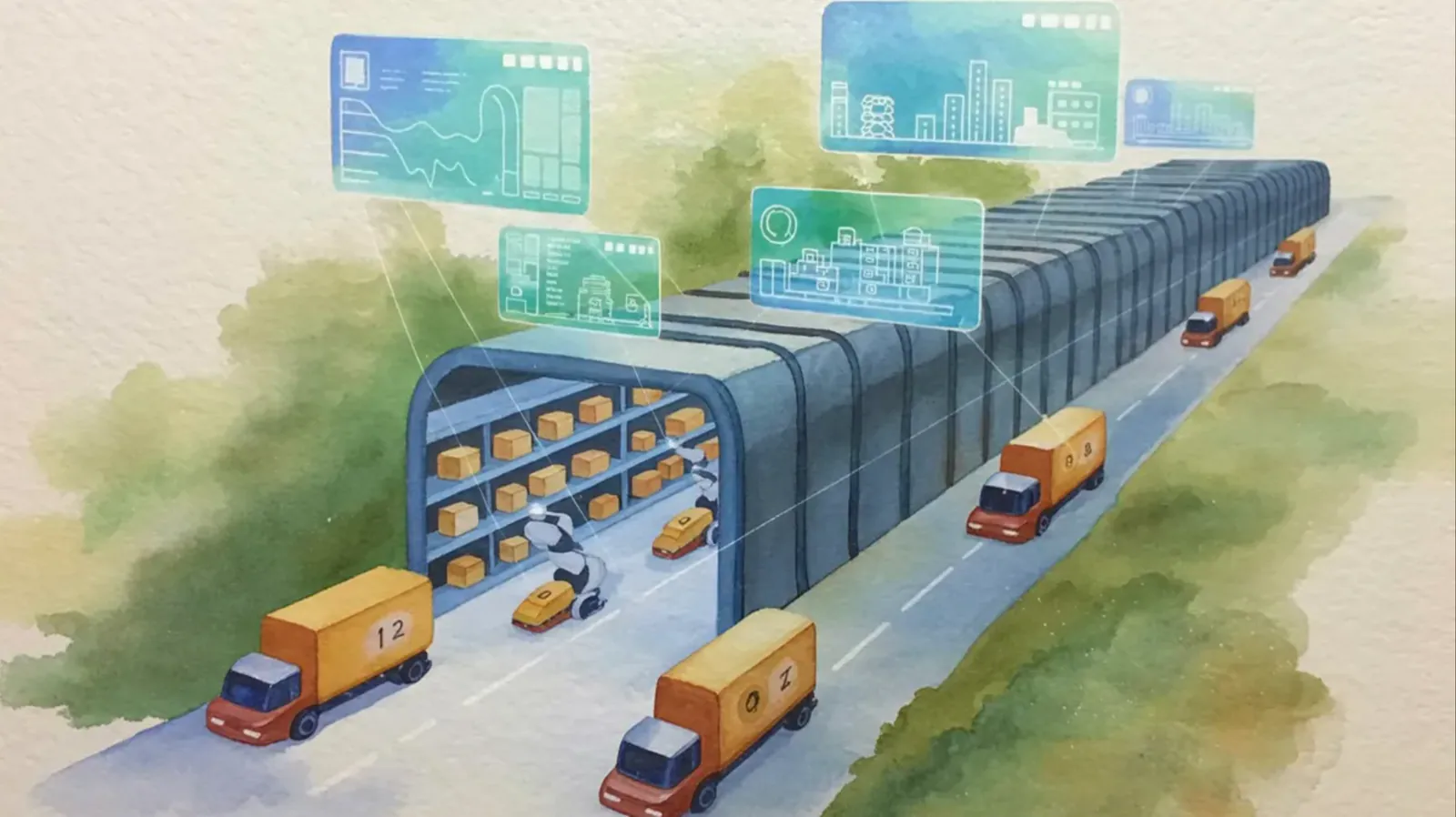
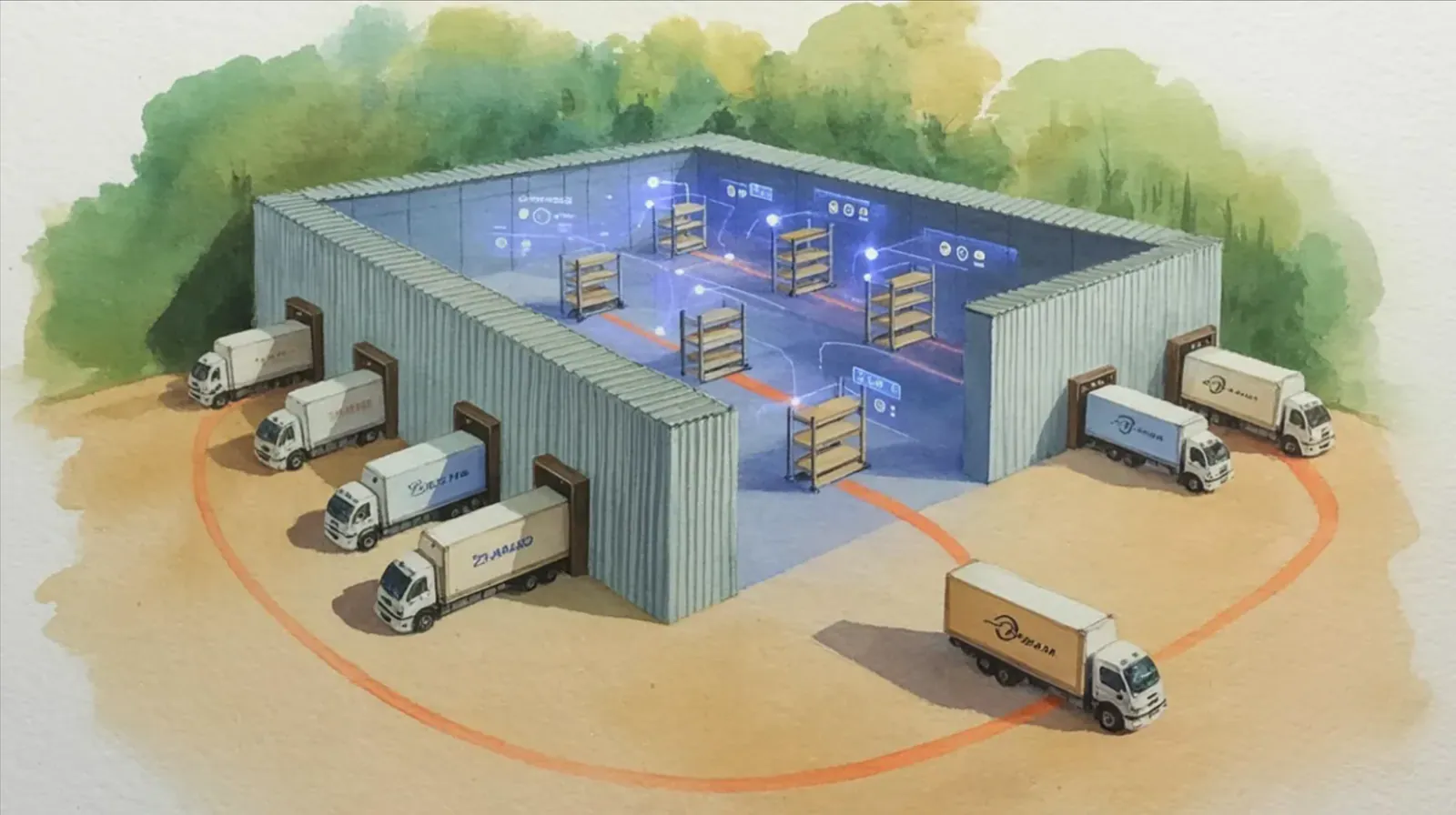
Logistics has always been a fine balancing act. You have to move products, control costs and meet the expectations of customers who want more every day.
The problem is that the board has become much harder to play. Operating costs keep rising, supply chains break down without warning and knowing what is happening in real time is still a headache.
Fortunately, there is a tool that is changing the rules: artificial intelligence in logistics. And no, it is not science fiction or a promise for a decade from now.
It is already moving trucks, organizing warehouses and predicting demand at real companies, today. In this guide we will walk through (in a simple way and without unnecessary jargon) how it works and where it makes sense to apply it.
Why did logistics become so complicated?
Think of logistics as the veins of a company. If something gets blocked at one point, the whole body feels it.
For years, the sector ran on rigid systems and a huge amount of manual work. It worked, but at the cost of inefficiencies that were barely noticeable when everything was calm.
Today the context is different. Order volumes are growing, customers want everything yesterday and any break in the supply hits hard.
The good news is that AI applied to the supply chain targets exactly these points. It improves visibility, strengthens resilience and optimizes the tasks that consume the most resources.
What does artificial intelligence really do in logistics?
Let's take the mystery out of it. In this context, AI is basically a system that learns from data to make better decisions (faster than any person).
Imagine an employee who never sleeps, reads millions of data points per second and learns from every mistake. That is, in essence, what machine learning brings to logistics operations.
It does not replace your team. It frees them from repetitive tasks so they can focus on what really moves the needle.
And the best part: these systems get smarter over time, because every new piece of data trains them a little more. Let's look at the most powerful use cases, one by one.
Demand forecasting: predicting the future (with data)
Demand forecasting is the heart of any logistics planning. If you know how much you will sell, you know how much to buy, how much to store and how many people you need.
Traditional methods fail when data is highly variable or changes all the time. AI, on the other hand, combines historical information with real-time signals to be far more accurate.
These algorithms take into account seasonality, promotions and even the consumption habits of each region. With that, they give you a living forecast that adjusts itself.
What do you gain from good predictive analytics? Here is a summary:
Fewer stockouts, because you have the product right when the customer looks for it.
Less tied-up capital, since you stop filling the warehouse with goods that do not turn over.
Better staff planning, anticipating work peaks before they arrive.
Happier customers, because you deliver on what you promised without surprises.
This is where conversational analytics comes in. With a tool like Metrix, a manager can ask the system for data as if talking to a colleague, without wrestling with complex dashboards.
Supply planning that adapts on its own
Supply planning coordinates materials, production and distribution so everything arrives on time. The old model was reactive: it was updated every so often and with fixed rules.
AI turns that around completely. Now the system adjusts reorder points, safety stock and even production schedules on its own.
For example, if it detects a sudden increase in demand, it triggers material orders before a bottleneck forms. And if demand drops, it recommends slowing down replenishment so you do not end up with excess product.
The result is a leaner, more flexible chain. You operate with less inventory, generate less waste and react within minutes to any unexpected event.
Warehouses that think: robots and automation
The warehouse is no longer that slow, chaotic place. Today it can be one of the smartest points in the entire operation.
Warehouse robots
Warehouse robots automate tasks such as picking, packing, sorting and inventory control. The result is faster processing, more accuracy and lower labor costs.
What is interesting is that they adapt to their environment. If the workflow changes, the robot adjusts its route without anyone having to reprogram it by hand.
Damage detection with computer vision
A damaged product does not just cost money, it also makes you lose the customer. Manual inspections are slow and make more mistakes as volume grows.
Computer vision analyzes thousands of images in real time to detect anomalies that the human eye would miss. It identifies the type of damage, isolates the affected product and keeps the problem from escalating.
Predictive maintenance: fix it before it breaks
A machine stopping suddenly is one of the most expensive things that can happen to an operation. It halts everything and drives up repair costs.
Predictive maintenance uses sensors and algorithms to detect unusual patterns before the failure happens. It is like having a mechanic who listens to the engine and tells you: "hey, this is going to break next week".
That way, your technical team acts in time. They replace the right part at the right moment and avoid the shutdown that would cost you a fortune.
This extends the useful life of assets and makes the whole logistics operation more reliable. Fewer surprises, more predictability.
The last mile: where you win or lose the customer
If there is one stage that defines the customer experience, it's the last mile. It's the final stretch, the most expensive and the hardest to coordinate.
This is where AI shines with route optimization. Instead of following a fixed route, the system calculates the most efficient path using real-time traffic data and historical delivery information.
The benefits are direct and show up right away:
Lower fuel consumption, because shorter, smarter routes are chosen.
Faster deliveries, which improves how customers perceive your service.
A smaller carbon footprint, a point that is increasingly valued.
A platform like Trazzo brings this logic to the field, coordinating last-mile deliveries with dynamic assignment and live tracking. The driver knows where to go and the customer knows when their order arrives.
AI agents: the new colleague on the logistics team
Here comes one of the most powerful developments. Artificial intelligence agents don't just analyze data, they make decisions and carry out actions on their own.
In a logistics environment, an agent can reallocate inventory, reroute shipments and respond to disruptions almost instantly. It also simulates "what if...?" scenarios to help you plan.
The best part is how you talk to them. You ask a question in natural language, as if you were writing to a coworker, and it answers with real data behind it.
This way, analyzing inefficiencies or resolving a disruption goes from hours to minutes. The agent becomes one more member of the team, available 24 hours a day.
Less paperwork, more action: back office automation
Every logistics operation hides a mountain of administrative tasks. Invoices, delivery notes, rate sheets and forms that someone has to enter by hand.
Document automation takes care of that. It extracts the data, reconciles errors and prepares the documentation without constant human intervention.
Think about all the time your team spends copying numbers from a piece of paper into a system. A solution like Arconte processes those documents automatically and gives those hours back to your people.
And it doesn't stop at documents. Hyperautomation combines several technologies to handle scheduling shipments, generating reports and even sending emails to the right people.
Customer service that never sleeps
In logistics, customers call right when something didn't go as expected. And they usually want answers now.
AI chatbots handle the most common inquiries without making anyone wait. They can track a shipment, change an order, schedule a delivery or answer frequently asked questions.
The good part is that they work across many channels at once, from your website to WhatsApp. That way, customers choose where to talk and always get an answer.
Meanwhile, your team is freed from repetitive inquiries. Your people stay available for the complex cases, the ones where human judgment is truly needed.
How much do you really save with AI?
This is the million-dollar question. And the answer is that the savings don't come from just one place, but from several at the same time.
Here is a breakdown so it's easy to follow:
Inventory: by aligning stock with real demand, you free up capital that was sitting idle in the warehouse.
Transportation: with optimized routes, fuel and shipping costs go down.
Maintenance: by avoiding unexpected failures, you reduce emergency repairs and get more out of every machine.
Labor: by automating repetitive tasks, you cut overtime and move staff to where they add the most value.
Add all that up and the impact on profitability is huge. We're not talking about improvements of a couple of points, but about transforming the cost structure of the operation.
What to watch out for: data, ethics and security
All this power comes with a responsibility. AI is not magic and it takes judgment to use it well.
The first point is algorithm bias. If you train a system with incomplete data, you will get skewed decisions, so it's a good idea to audit them often.
The second, and perhaps the most sensitive, is data security. Logistics systems handle sensitive customer and supplier information that must be protected, no exceptions.
That's why, before adopting any tool, it's worth reviewing how it protects information. At Vantegrate we treat platform security as a non-negotiable foundation, not an extra.
AI doesn't replace experience: it amplifies it
Here is a myth worth dismantling. Many people believe artificial intelligence is coming to take the human factor out of the equation.
It's the opposite. AI delivers real results when it builds on years of business knowledge and a solid integration with the systems you already use.
A company can have the best algorithm in the world, but if it can't connect it to its ERP or its CRM, it stops halfway. That's why the partner who works with you matters so much.
As partners of leading platforms like Salesforce and Oracle, we know that real value appears when AI talks to the rest of your technology. That is where an operation stops being merely efficient and becomes intelligent from end to end.
Where do you start?
You don't need to transform everything overnight. The key is to pick one specific pain point and tackle it first.
Maybe it's the last mile, maybe demand forecasting or the back office paperwork. Start where it hurts the most and let the results speak.
If you want to see how it would work in your operation, the best approach is to try it with your own data. You can book a demo and find out, concretely, how much you can move with less effort.
Frequently asked questions
Is artificial intelligence in logistics only for large companies?
Not at all. There are cloud-based tools with pay-as-you-go pricing that let you get started without a big upfront investment. A small or mid-sized business can start with route optimization or a chatbot and grow from there.
How long does it take to see a return on investment?
It depends on the use case, but many solutions show results within a few months. Document automation and route optimization are usually among the ones whose impact shows up fastest in your bottom line.
Is AI going to replace logistics employees?
The goal is not to replace people but to free them up. AI takes care of repetitive work so people can focus on strategic tasks, such as improving supplier relationships or overseeing the systems themselves.
Do I need to replace all my systems to use AI?
Not necessarily. Well-designed solutions integrate with your ERP, your CRM and your current platforms, adding intelligence without forcing you to tear down what already works.
Where should I start if I've never used AI in my operation?
With one specific, measurable problem. Pick a task that currently costs you time or money, apply a focused solution and use those first results to justify the next steps.