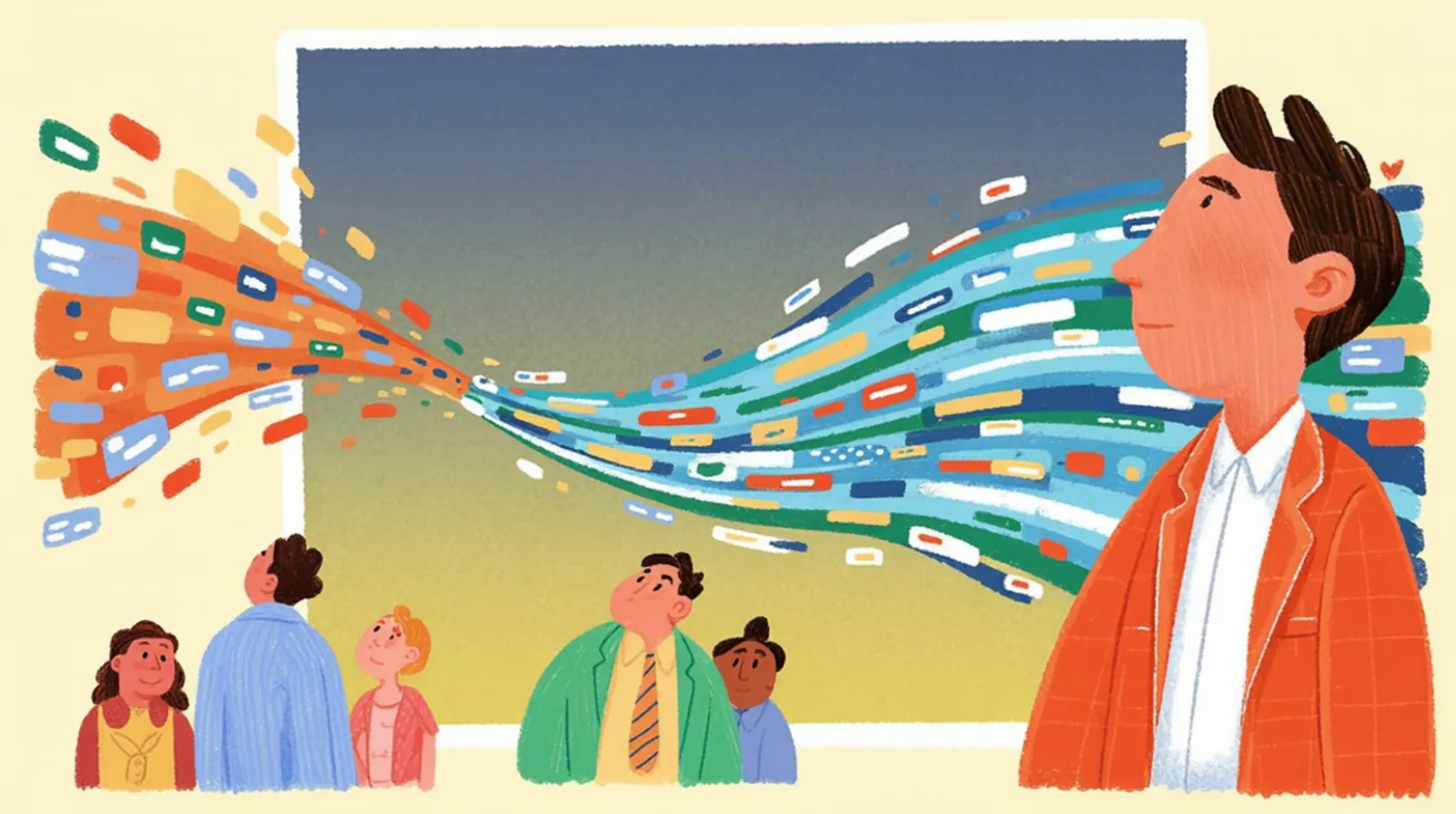

Every so often a headline shows up promising the end of the working world as we know it. This time it's artificial intelligence's turn. "AI agents will replace employees", "50% of jobs will disappear", "get ready for mass unemployment".
The story is seductive because it mixes a little science fiction with a touch of real anxiety.
That story has been repeated almost word for word for more than two hundred years. Without exception, it has always ended up being wrong.
Let's take the myth apart.
But first, a question for the business leaders reading this: have you ever heard that the spreadsheet was going to leave every accountant without a job? Spoiler: the exact opposite happened.
The "lump of labor" fallacy and why it fools us so often
In economics there is a concept with an unglamorous name but very high explanatory power: the fallacy of finite work (known in the literature as the lump-of-labor fallacy).
The idea behind the myth is simple: there is a fixed amount of useful work in the world, and if a machine (or an AI agent) does part of it, then humans will have to do less.
It sounds logical. But it is wrong.
Human needs, desires and curiosity are not finite. Every time a new technology freed us from a repetitive task, society didn't just sit back sipping tea on the couch.
What we did was invent new industries, new professions and new problems to solve.
Keynes, in a 1930 essay, claimed that automation would lead us to a 15-hour workweek. How many hours do you work?
Exactly. Automation happened. But we didn't spend our time resting: we started doing other things, generally more complex and better paid.
What history tells us (and pessimists prefer to ignore)
When a transformative technology arrives, the same thing usually happens: initial panic, adjustment, expansion and reorganization. Let's look at three classic cases before getting into AI.
The tractor that was going to destroy the countryside
In 1900, 41% of US workers were in the agricultural sector. By 2000 it was 1.9% (USDA, 2005). If automation caused permanent unemployment, the tractor would have destroyed the labor market forever.
And yet, what happened? Agricultural output almost tripled: in 2023 it was almost three times that of 1948 (USDA). That abundance drove enormous population growth. And the workers who left the farm found jobs in industries that didn't exist before: factories, offices, hospitals, laboratories and, later on, the software sector.
Yes, the tractor changed the life of the farmhand. But in doing so, it opened the door to a much larger, more diverse and, on average, better-paid economy.
The electrification that was going to "replace the workers"
The mass arrival of electricity in factories was not just a change in energy source. It completely reorganized the way people worked. It replaced shafts, pulleys and belts with individual motors. It made it possible to create goods that were previously unimaginable: washing machines, refrigerators, affordable cars.
The result? More demand for labor, not less. More sales reps, more administrative employees, more logistics workers, more financial services to sustain all the new consumption. Every productivity leap sets off a domino effect that ends up creating jobs in places nobody had anticipated.
Spreadsheets and the "extinction" of accountants
When VisiCalc and Excel appeared, some people were convinced that accountants would disappear. Why would we need them if a machine could do the math?
What happened was the opposite.
The number of finance professionals grew. An entire new industry emerged: financial analysis, planning, FP&A (Financial Planning & Analysis).
Accountants didn't disappear: they became analysts, consultants and strategists. The spreadsheet freed them from manual work and pushed them toward higher-value tasks.
If you want to see how this principle applies today to the world of data, it's worth learning how tools like Metrix, the conversational business intelligence agent, work. It doesn't replace the analyst: it amplifies them.
The favorite case: travel agents
There is one example worth examining closely because it is the closest to the current AI phenomenon. Remember when trips were booked through travel agencies?
Yes, employment at US travel agencies fell to less than half of its dot-com era peak, driven by the internet and by airline commission cuts (Stripe Economics, 2026). The substitution happened and it was real. But here comes the interesting part: the displaced workers found jobs in other industries. And the travel agents who did stay in the field started earning more.
In 2000, travel agency employees earned on average 87% of the average weekly wage in the private sector.
In 2025 that ratio was already 99% (Stripe Economics, 2026). Those who stayed in the trade now earn more because technology made their work more productive and more specialized.
That is the story the prophets of doom don't tell you: even when a technology destroys jobs, it usually creates better jobs elsewhere, and the people who stay become more valuable.
Augment is the keyword (not replace)
Here is a crucial distinction that changes the whole conversation. Artificial intelligence can:
Replace: do a job that a person used to do, with no human involvement.
Augment: boost a person's work, making them more productive, faster and, therefore, more valuable.
For some roles, AI is an existential threat.
For others (most of them), it is a force multiplier. Recent estimates show that augmentation effects far outweigh replacement effects.
Leadership teams understood this before the pessimistic analysts did: on investor calls, mentions of "AI as augmentation" far outnumber those of "AI as replacement," according to an analysis by Andreessen Horowitz.
Software development is the perfect example. AI helps a programmer write code faster and better. Are there fewer programmers? No: there is more demand.
More companies are building products that were impossible before, and they need professionals who know how to work with these new tools. Salaries go up, not down.
At Vantegrate we saw this phenomenon from the inside.
When a company adopts well-designed AI agents, it doesn't lay off its sales team: it frees them from repetitive tasks.
That is exactly what Sellium, our WhatsApp sales agent, does: it takes care of qualifying leads, answering frequent questions and moving conversations forward, while the human team focuses on what it does best: closing complex sales and building long-term relationships.
How does a sales rep's job change when working alongside an agent?
The idea of augmenting instead of replacing becomes concrete on a sales team. When an agent handles the company's WhatsApp, the sales rep doesn't lose their job: what they do in a normal week changes.
They stop being the first filter: questions about price, stock, hours and order status get resolved without them. They join the conversation when there is a real opportunity, with the history and data already loaded in the CRM.
They start the day with a list, not a full chat inbox: instead of going through dozens of unread messages, they receive the conversations that need their judgment, such as a negotiation, an unusually large volume or a customer who asked to talk to someone.
They teach the agent: when an answer isn't convincing, the sales rep is the one who knows best what it should look like. Reviewing conversations and correcting criteria becomes part of the job, just as coaching a new sales rep used to be.
They are measured differently: if the agent handles the volume, counting messages answered makes less sense. What matters is how many of the opportunities they receive move forward and close.
The change is not automatic. A team that doesn't know what the agent does distrusts it, and one that doesn't take part in defining when the agent hands over a conversation ends up receiving half-finished cases. That is why the handoff from the agent to a sales rep is designed with the sales team, not for it.
What the data shows (here and now)
So far, a mix of theory and history. But what do current studies say about the real impact of AI on employment?
The most recent findings are consistent:
There are no significant changes in total employment attributable to AI.
There is task reallocation: routine administrative activities are more vulnerable, while analytical, technical and managerial ones tend to be complemented by AI.
More than 90% of the executives surveyed in the United States, the United Kingdom, Germany and Australia see no impact of AI on their company's employment over the last three years (NBER, 2026).
Where AI augments human work, wages grow above trend.
There is one exception worth a closer look: certain entry-level positions in industries highly exposed to AI are becoming harder to land.
But the same studies show that in industries where AI acts as an augmentation (not as a replacement), entry-level positions are growing.
The aggregate verdict, for now, is clear: stability with reorganization. Some roles shrink, others expand, others are invented.
The jobs that don't exist yet
This is probably the most fascinating part of the story. Most of the jobs that seem normal to us today didn't exist 80 years ago:
Programmer.
Digital marketing specialist.
UX designer.
Cloud migration consultant.
Cybersecurity specialist.
If someone had asked you 25 years ago to imagine all the jobs that would emerge thanks to the internet, you might have guessed a few. But who predicted the entire cloud computing industry, community managers, content creators, growth analysts?
The same happens with AI.
New roles are already appearing:
Model auditors.
Conversational experience designers.
Industry-specific model trainers.
AI agent security specialists.
That last category, security, is one of the topics we care about most.
That is why we built a platform with enterprise-grade security standards: we know the future of AI agents in serious organizations depends on trust being total.
Why experienced companies win this race
Here is an uncomfortable truth for those who forecast the end of work: serious enterprise AI adoption is not done with a chatbot put together in an afternoon. It is done with robust, integrated, secure platforms that know the business and talk to the company's critical systems.
The artificial intelligence agents that move the needle are the ones that connect to the ERP, read the product catalog in real time, respect each user's permissions, escalate to human teams when appropriate, and leave a trace of every decision.
That takes enterprise software experience, not weekend enthusiasm.
Vantegrate was born precisely from that observation: too many companies were trying to implement AI agents that failed because they could not operate in real environments.
We have spent decades working with platforms like Salesforce and Oracle; we understand how the back office works and how not to break anything when introducing intelligent automation.
That is why, when it comes to building AI agents that integrate with Salesforce or with the Oracle stack, the difference between an experiment and a production solution lies in the technical depth of the partner.
The future is expansion, not contraction
If you still need convincing, look at this: the creation of new companies is surging, largely correlated with AI adoption.
The number of new apps reaching digital stores keeps growing at a steady pace. Entire industries (advanced robotics, for example) that once seemed like science fiction are entering the scene because intelligence is now available and cheap.
Will there be difficult transitions? Yes. Will some jobs shrink? Also yes.
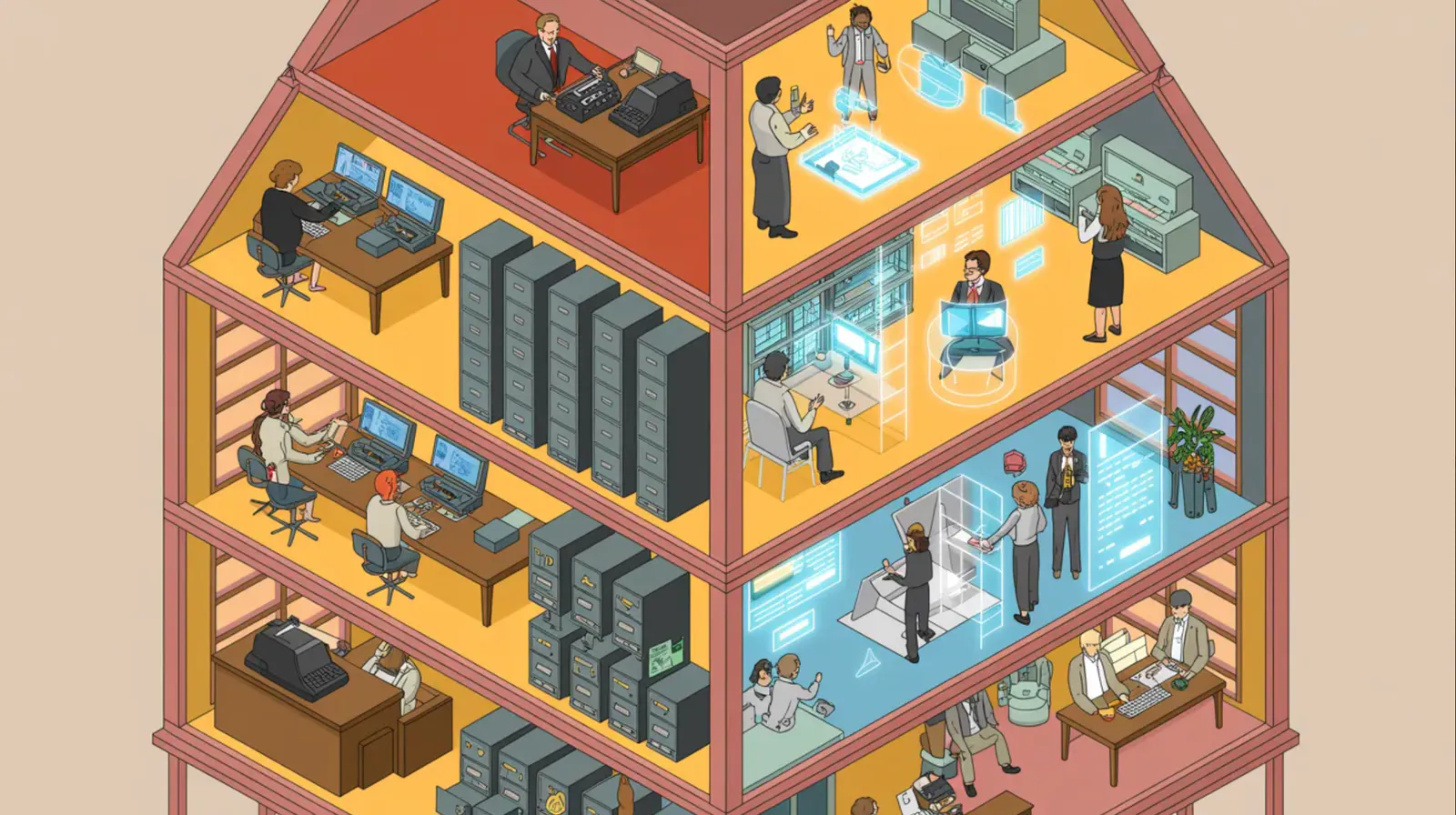
Historically, automation removes repetitive tasks from work and moves humans up to higher, more creative layers. Some roles will have to reinvent themselves. And as a society, we should invest in serious training programs.
But the idea that we have reached the limit of human ingenuity (that we have already thought of everything there was to think of and that a machine can now do it all) is, frankly, a spectacular failure of imagination.
Every time the cost of a powerful input falls, the economy does not stand still: it expands, diversifies and creates new categories of value.
How to position your company for this new era
AI is not the end of knowledge work. It is the beginning of something much more interesting: an era in which intelligence is abundant, the problems we can tackle are more ambitious, and we humans can focus on doing what we do best (imagining, connecting, deciding, creating).
If you are thinking about how to position your company in this new landscape, the question is not whether you will use AI. It is about choosing carefully who you will do it with and starting with the processes where the return is clearest: sales, customer service, data analysis, document processing and logistics.
We invite you to book a demo and see, in concrete terms, how AI agents can help you expand, not replace, what you are already doing.
You will find that work is not ending: it is reinventing itself. And those who understand that in time will be on the right side of history.
Because in the end, the best news about artificial intelligence is this: there has never been a better time to have ideas, build new things and push the limits of what is possible.
AI does not take our work away. It gives us more work than is worth doing.
Frequently asked questions about AI and employment
Will AI agents really eliminate jobs en masse?
The available evidence shows that the aggregate impact of AI on employment is, so far, neutral or slightly positive. There is task reassignment within companies, but more than 90% of executives surveyed in four countries see no impact of AI on their company's employment over the last three years (NBER, 2026).
Which types of tasks are most vulnerable to AI?
Routine, repetitive and highly structured activities (such as basic administrative processing, transcription and handling frequent inquiries) are the most exposed. Tasks that combine analysis, judgment, creativity or relationship management tend to be complemented, not replaced, by AI.
Should you wait and see what happens before adopting AI agents?
Waiting has an increasingly high cost. Companies that are integrating AI agents today are building operational advantages (in response speed, team productivity and customer experience) that will be hard to catch up with later. The recommended approach is to start with well-defined processes, measure the results and scale.
How do you choose an AI partner for a mid-sized or large company?
Look for proven experience in enterprise software, not only in language models. A good partner should understand ERP and CRM integrations, handle enterprise security standards, provide traceability of every agent decision and have real use cases in your industry.