


















Generative AI is the branch of artificial intelligence that creates new content (text, images, audio or code) from patterns learned on large volumes of data. Unlike traditional AI, which classifies or predicts based on existing data, generative AI produces: it drafts an email, summarizes a contract, generates a product image or writes a database query. That ability to generate language and useful artifacts is what made it the foundational technology of the current wave of automation in companies.
What is generative AI used for in a company?
Business use cases concentrate on tasks where the bottleneck is producing or interpreting content. Among the most mature:
- Support and sales: drafting replies, quotes and follow-ups in natural language, in the channel where the customer is.
- Marketing: generating message variants, campaign copy and segmentations from a single idea.
- Operations and administration: reading invoices, contracts and forms to extract structured data without manual typing.
- Data and analysis: turning a question in plain English into a query on your systems and returning the answer with an explanation.
- Development: suggesting and completing code, speeding up technical teams.
According to McKinsey, generative AI could add between 2.6 and 4.4 trillion dollars of annual value to the global economy, spread across 63 use cases, with most of the impact concentrated in customer support, marketing and sales, software engineering and research.
How is generative AI different from an AI agent?
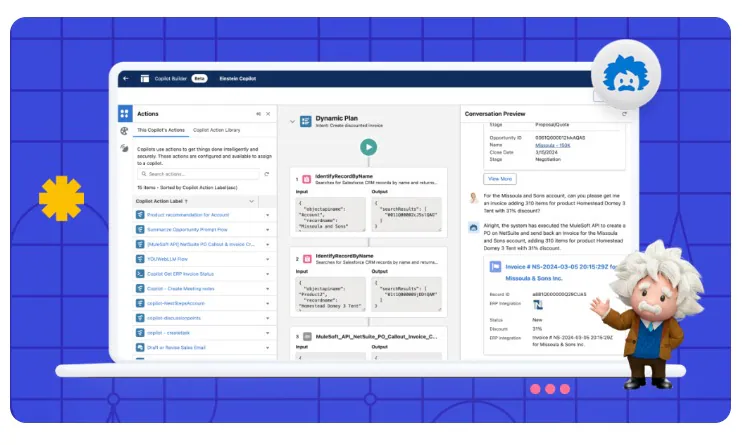
It is the key distinction and the source of the most confusion. Generative AI is the foundational technology: the engine that understands and produces language. An AI agent is a system that uses that capability to act end to end: it decides, queries systems, executes steps and completes a task with a goal. In short: the generative model writes the answer; the agent solves the problem (quotes, collects, schedules, updates the CRM) relying on that model. A good agent combines generative AI with memory, business rules and a connection to your tools.
How do you apply generative AI safely?
The real value appears when content generation is bounded by business context (your prices, your catalog, your policies) and by quality and privacy controls. Without those limits, the model can invent data or drift from your brand tone. That is why serious implementations start from a specific, measurable use case, not from "using AI" in the abstract.
At Vantegrate, all of our AI agents (Sellium, Revio, Metrix, Arconte and Trazzo) rely on generative AI to understand and write, but they add the layer that turns it into results: the ability to act inside your processes. Learn how we bring this technology to concrete sales, data and operations tasks.